Shop by

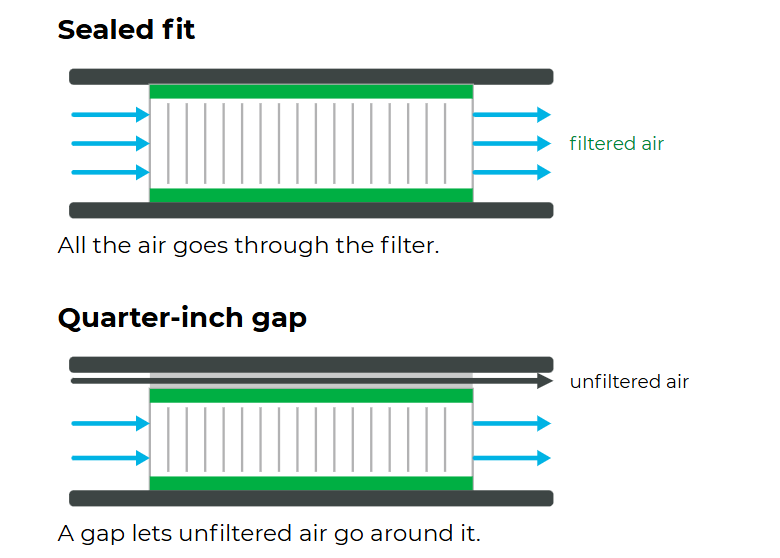
Here's something most homeowners don't realize: a filter that's installed with even a quarter-inch gap around the frame lets unfiltered air bypass the media completely โ sending dust, allergens, and debris straight into your ductwork and living spaces. At Filterbuy, we've manufactured millions of filters across more than 600 sizes, and our customer service team hears it all the time: "I just changed my filter, so why is my house still dusty?" Nine times out of ten, the issue isn't the filter itself โ it's the installation.
A proper filter swap takes less than five minutes, but a few small details make the difference between real protection and a false sense of security. This guide shares what we've learned from over a decade of manufacturing experience and feedback from more than two million households โ including the most common installation mistakes we see, how to get a sealed, gap-free fit every time, and what to do if your filter slot doesn't match standard sizing. You're already taking the right step by changing your filter regularly. Let's make sure every change actually counts.
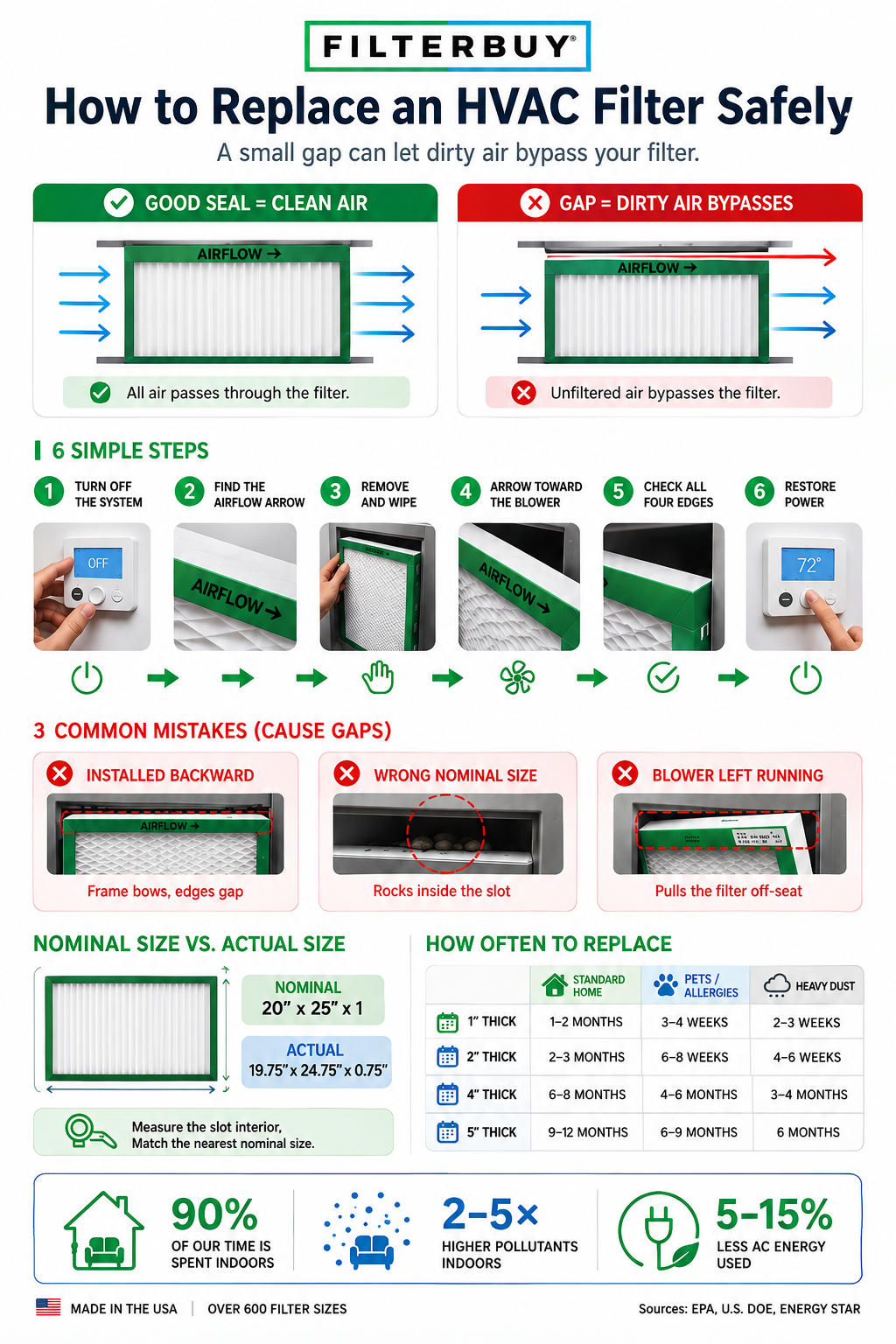
To replace your HVAC filter without leaks or gaps, follow these six steps:
Key insight from our manufacturing team: After producing millions of filters across more than 600 sizes and serving over two million households, we've found that the most common cause of poor air quality after a filter change isn't the filter. It's the installation. A gap as small as a quarter inch around the frame lets unfiltered air bypass the media entirely. Measure your filter slot before ordering, match the airflow arrow to the correct direction, and confirm a snug fit every time. A properly installed filter protects your family's air, reduces energy consumption by 5% to 15% according to the U.S. Department of Energy, and extends the life of your HVAC system.
Your HVAC filter is the only line of defense between the air your family breathes and the contaminants circulating through your home. When a filter is installed incorrectly โ crooked, undersized, or loosely seated- it creates bypass air. That's the industry term for unfiltered air that slips around the filter frame instead of passing through the media. Bypass air carries dust, pollen, pet dander, mold spores, and other particles directly into your ductwork, where they recirculate through every room in your home.
Beyond air quality, a poorly seated filter forces your HVAC system to work harder. Unfiltered debris accumulates on your evaporator coil and blower motor over time, reducing efficiency and potentially leading to costly repairs. According to the U.S. Department of Energy, a clean, properly installed filter can lower your HVAC system's energy consumption by 5% to 15%. That small detail at the filter slot has a direct impact on your energy bills, your equipment lifespan, and your family's health.
Not all HVAC systems are built the same, and knowing where your filter lives is the first step toward a proper replacement. Most residential systems use one of three common filter locations: a return air vent (typically on a wall or ceiling), a slot built into the air handler or furnace unit itself, or a filter grille mounted in a hallway or utility closet. If you're unsure which setup you have, check the area where air gets pulled into the system โ that's your return side, and that's where the filter goes.
Before removing anything, turn off your HVAC system. This isn't just a safety precaution โ it prevents unfiltered air from being pulled through the system while the filter slot is empty. Even a few minutes of running without a filter can deposit a surprising amount of debris on your evaporator coil. From our experience working with homeowners across the country, this is one of the most commonly skipped steps, and one of the easiest ways to protect your equipment.
Once your system is off and you've located the filter slot, follow these steps for a clean, gap-free installation:
Open the filter access panel or return vent cover. Some are held in place by latches or clips, while others may require unscrewing a grille. Take note of how the old filter is positioned before pulling it out.
Check the airflow arrow on the old filter. Every HVAC filter is printed with a directional arrow that indicates which way air should flow through the media. This arrow should always point toward the blower motor, in other words, toward the direction of airflow into the system, away from the return side. Getting this backwards is one of the most common mistakes we hear about from our customer support team, and it compromises both filtration efficiency and system performance.
Slide the old filter out and inspect the filter slot. Look for dust buildup, debris, or damage around the frame and edges. Wipe down the housing with a dry cloth if needed. A clean slot means a better seal for your new filter.
Insert the new filter with the airflow arrow pointing in the correct direction. The filter should fit snugly within the housing with no bowing, bending, or visible gaps around the edges. If you can see light around the frame or the filter shifts easily once installed, the fit isn't tight enough, and that's where bypass air becomes a problem.
Close the access panel or reattach the vent cover, then turn your HVAC system back on. Listen for any unusual whistling or rattling sounds, which can indicate the filter isn't seated correctly or the housing has a gap.
After more than a decade of manufacturing filters and gathering feedback from over two million households, we've identified the mistakes that come up again and again.
Installing the filter backwards is the most frequent one. A reversed filter still captures some particles, but the media is engineered to work in one direction. Flipping it reduces efficiency, restricts airflow, and can cause the filter to collapse under pressure over time.
Using the wrong size is another issue we see constantly. A filter that's even slightly too small leaves gaps around the edges, and one that's too large will bow or buckle when forced into the slot. Both scenarios create bypass air. Always verify your filter dimensions by measuring the slot itself rather than relying on the size printed on your old filter, which may reflect a nominal size rather than the actual dimensions.
Forgetting to remove packaging material happens more often than you'd expect. Some filters ship with cardboard backing, plastic wrap, or protective tabs that need to be removed before installation. Leaving any of that in place blocks airflow and defeats the purpose of the replacement entirely.
Neglecting to turn off the system during the swap may seem minor, but as we mentioned, it exposes your equipment to unfiltered air and can pull loose debris into the ductwork during the transition.
A perfect fit is essential for effective filtration, but not every filter slot matches a standard size. If you're dealing with a gap between the filter and the housing, there are a few things to check. First, re-measure the filter slot carefully, length, width, and depth, and compare those numbers to your filter's actual dimensions, not the nominal size on the label. Nominal sizes are rounded for convenience, but actual sizes are typically a quarter to a half inch smaller.
If your system requires a size that's hard to find at local retailers, that's where having access to a manufacturer with a broad range matters. Filterbuy offers over 600 standard filter sizes and also manufactures custom sizes for non-standard filter slots, because we believe an exact fit shouldn't be a luxury. A filter that's built to match your specific housing eliminates gaps, maximizes filtration, and ensures your HVAC system performs the way it was designed to.
Even a perfectly installed filter loses effectiveness as it loads up with captured particles. For standard 1-inch filters, the general recommendation is every 60 to 90 days for a typical household. However, your ideal replacement schedule depends on several factors: the number of people in your home, whether you have pets, local air quality conditions, and whether anyone in the household manages allergies or asthma.
Homes with multiple pets or allergy sufferers may benefit from changing filters every 30 to 45 days. Thicker filters, 4-inch or 5-inch media, generally last longer, often up to six months or more depending on conditions, because they have more surface area to capture particles before becoming fully loaded. The best approach is to check your filter monthly and look for visible discoloration or reduced airflow, which are clear signals that it's time for a swap.
Staying on a consistent replacement schedule is one of the simplest and most impactful things you can do to protect your indoor air quality and your HVAC investment. You're already the one looking out for your family's comfort and health, making sure every filter change is done right just takes that protection one step further.
"After manufacturing millions of filters and hearing from over two million households, the number one issue we see isn't a bad filter. It's a bad fit. A quarter-inch gap around the frame can undo everything a quality filter is designed to do, and most homeowners never realize it's happening."
โ Filterbuy Air Quality Team
Don't take your filter installation for granted. A new filter only protects your family if it's the right size, the right efficiency rating, and seated properly in the housing, with no gaps letting unfiltered air slip through. After manufacturing filters for over a decade and helping more than two million households breathe easier, we know that the difference between real protection and a false sense of security often comes down to details most homeowners never think to check.
We've put together seven resources, from trusted government authorities and our own manufacturing team, that cover everything you need to get your filter replacement right. Because protecting your family's air, your home's comfort, and your HVAC investment shouldn't require guesswork.
U.S. Environmental Protection Agency (EPA) โ Guide to Air Cleaners in the Home
Here's something worth knowing: your HVAC filter is one of the only things standing between your family and the invisible contaminants circulating through your home. The EPA's consumer guide breaks down how residential filters capture airborne particles, how filtration efficiency varies by filter type, and why even the best filter can't do its job if air is bypassing the media through installation gaps. If you want to understand the "why" behind proper filter replacement, start here.
https://www.epa.gov/indoor-air-quality-iaq/guide-air-cleaners-home
U.S. Department of Energy (DOE) โ Air Conditioner Maintenance
Most homeowners don't realize that a filter installed with gaps or left in place too long doesn't just compromise air quality; it actively damages your HVAC system. The DOE explains how obstructed or bypassed airflow causes dirt to accumulate on your evaporator coil, reduces heat-absorbing capacity, and forces your equipment to work harder than it should. This is exactly why we stress turning off your system during every replacement and making sure your new filter seats snugly with no visible gaps around the frame.
https://www.energy.gov/energysaver/air-conditioner-maintenance
ENERGY STAR โ How to Keep Your HVAC System Working Efficiently
You don't need to be an HVAC technician to replace your filter like one. ENERGY STAR's maintenance guide walks you through the entire process, locating your filter, checking for a tight fit, and sealing any gaps around the frame that could let unfiltered air through. They also confirm what we've seen firsthand across millions of customer interactions: dirt and neglect are the number one cause of heating and cooling system failure. A few minutes of attention during each filter swap prevents problems that cost hundreds to fix.
https://www.energystar.gov/products/ask-the-experts/how-keep-your-hvac-system-working-efficiently
ASHRAE โ Filtration and Disinfection FAQ
When you see a MERV rating on your filter, that number comes from ASHRAE, the American Society of Heating, Refrigerating, and Air-Conditioning Engineers, which developed and maintains the testing standard the entire filtration industry relies on. Their FAQ explains how MERV values are determined, what particle sizes each rating captures, and how to match a filter's efficiency to your system's airflow requirements. Understanding this helps you avoid two common mistakes we see all the time: choosing a filter that's too weak to protect your air quality, or one that's too restrictive for your system to handle.
https://www.ashrae.org/technical-resources/filtration-and-disinfection-faq
Building Science Education (DOE) โ HVAC Proper Installation of Filters
Where your filter sits and how it's oriented in the housing matters more than most people think. This DOE-backed resource covers proper filter positioning on the return side of the air handler, explains why an incorrectly placed filter increases energy consumption and motor wear, and reinforces the importance of accessible filter locations that make consistent replacement easier. Based on our experience, homeowners who understand their system's filter location are far more likely to stay on a regular replacement schedule, and that consistency is what keeps your air clean and your equipment running efficiently.
https://bsesc.energy.gov/energy-basics/hvac-proper-installation-filters
Filterbuy โ How to Measure Your Air Filter: Complete Step-by-Step Guide
After manufacturing filters across more than 600 sizes, we can tell you that the most common reason a filter doesn't fit properly isn't a bad filter; it's a bad measurement. This guide from our manufacturing team walks you through measuring your filter slot's exact length, width, and depth, explains the critical difference between nominal and actual sizing that trips up most homeowners, and covers what to do when your HVAC system requires a non-standard or custom dimension. A few minutes with a tape measure can be the difference between a sealed, protected system and one that's letting unfiltered air straight through.
https://filterbuy.com/resources/air-filter-basics/measure-air-filter/
Filterbuy โ Which MERV Rating Should I Use?
Getting the right fit is half the equation. The other half is choosing a MERV rating that captures the particles your family needs filtered without restricting airflow or overworking your equipment. This guide breaks down how MERV 8, 11, and 13 filters perform in real households, from homes with pets and allergies to systems that need to balance efficiency with airflow. We built this resource from over a decade of manufacturing experience and real-world feedback from the families we serve, so you can choose with confidence instead of guessing at the store.
https://filterbuy.com/resources/air-filter-basics/which-merv-rating-should-I-use/
You're already taking the most important step by learning how to replace your filter the right way. These resources give you the expert knowledge and practical guidance to make every change count, protecting your family's health, extending your HVAC system's lifespan, and getting the full value from every filter you install. Because at Filterbuy, we believe better air starts with better information.
After manufacturing millions of air filters and working with more than two million households, we know what happens when filter installation goes right, and what goes wrong when it doesn't. These three statistics from leading U.S. authorities confirm what our team observes every day.
Statistic #1: Indoor Air Is 2 to 5 Times More Polluted Than Outdoor Air
The EPA reports that indoor pollutant levels are often 2 to 5 times higher than outdoor concentrations, and Americans spend roughly 90% of their time in these environments.
What does that mean for your filter installation:
The EPA's data reinforces what we see on the ground: your filter installation is either solving your indoor air quality problem or contributing to it.
Source: U.S. Environmental Protection Agency โ Indoor Air Quality
https://www.epa.gov/report-environment/indoor-air-quality
Statistic #2: A Clean, Properly Installed Filter Cuts Energy Use by 5% to 15%
The U.S. Department of Energy confirms that replacing a dirty filter with a clean one can lower your air conditioner's energy consumption by 5% to 15%.
Here's what most homeowners miss: a new filter installed with gaps creates the same problems as a dirty one.
We've tracked this pattern across our customer base for over a decade. Homeowners who measure their filter slot accurately, choose the correct size, and confirm a snug fit consistently report lower energy bills and fewer service calls. The DOE's savings figure isn't theoretical; it's the real-world result of doing the basics right.
Source: U.S. Department of Energy โ Maintaining Your Air Conditioner
https://www.energy.gov/energysaver/maintaining-your-air-conditioner
Statistic #3: Dirt and Neglect Are the #1 Cause of HVAC System Failure
ENERGY STAR reports that nearly half of the average home's $1,900 annual energy bill goes to heating and cooling. They identify dirt and neglect as the leading causes of system inefficiency and failure.
From a manufacturer's perspective, that doesn't surprise us. When customers contact our support team about persistent air quality issues, the root cause almost always traces back to one of three installation problems:
The system doesn't fail all at once. It degrades gradually, cycle by cycle, as dirt accumulates where it shouldn't. A five-minute filter replacement done correctly protects an investment that represents nearly half your household's total energy spend. It costs nothing extra to get it right.
Source: ENERGY STAR โ How to Keep Your HVAC System Working Efficiently
https://www.energystar.gov/products/ask-the-experts/how-keep-your-hvac-system-working-efficiently
The Bottom Line
The government research and our first-hand manufacturing experience point to the same conclusion. The difference between a filter that protects your home and one that doesn't comes down to three things: fit, placement, and consistency. Get those right, and every filter change actually counts.
After over a decade of manufacturing air filters across more than 600 sizes and hearing directly from the families who use them, we've arrived at a conclusion that might surprise you: the most common air quality failures we see have almost nothing to do with the filter itself.
The filter works. The engineering works. The MERV rating captures exactly what it's designed to capture. But none of that matters if:
In every one of those scenarios, you've spent the money, done the work, and walked away believing your home is protected, when unfiltered air is actually bypassing the media and circulating the same contaminants you were trying to eliminate.
Our honest take as a manufacturer: we believe the industry underestimates how much installation quality affects real-world filtration performance. Most educational content about air filters focuses on what to buy. Very little focuses on:
That gap in practical knowledge is costing homeowners money, shortening equipment lifespan, and leaving families breathing air they assume is clean but isn't.
This guide was built to close that gap. Every section is grounded in what we've learned from manufacturing millions of filters and serving more than two million households, not theoretical best practices, but the specific steps that separate a filter change that actually protects your home from one that just checks a box on a maintenance list:
You're already the person in your household who takes this seriously, the one researching the right way to do it instead of just sliding in whatever fits close enough. That mindset is exactly what keeps your family's air clean, your HVAC system efficient, and your energy costs under control.
The filter is the tool. You're the one who makes it work. And now you have everything you need to make every change count.
You have everything you need to replace your HVAC filter safely and correctly. Here's exactly what to do, starting right now.
Step 1: Check Your Current Filter
Walk over to your return vent or air handler and pull out the filter installed right now. Ask yourself three questions:
If any of these apply, fix it today, not next month.
Step 2: Measure Your Filter Slot
Don't trust the label on your old filter. Grab a tape measure and record:
Compare those numbers to the nominal size of your old filter. Nominal sizes are rounded. Actual sizes run a quarter to a half inch smaller. Even a small mismatch creates gaps.
Need help? Use our measuring guide: https://filterbuy.com/resources/air-filter-basics/measure-air-filter/
Step 3: Choose the Right MERV Rating
Match your filter's efficiency to your household's actual needs:
Not sure? Our MERV guide breaks it down by scenario: https://filterbuy.com/resources/air-filter-basics/which-merv-rating-should-I-use/
Step 4: Install It Right
When your new filter arrives, follow this sequence:
Total time: less than five minutes. Those five minutes protect your air, your equipment, and your energy costs for the next 60 to 90 days.
Step 5: Set a Replacement Schedule
The best filter stops working once it's fully loaded. Set a reminder based on your household:
Pro Tip: Check monthly regardless of schedule. Visible discoloration or reduced vent airflow means it's time, even if you're ahead of schedule.
Step 6: Keep Replacement Filters on Hand
The most common reason homeowners skip a filter change isn't laziness. It's not having a replacement ready. Solve that by:
The Bottom Line
You've already done the hardest part, learning what actually matters. Now it's about building the habit. One correct filter change every 60 to 90 days protects your family's air, extends your system's lifespan, and keeps energy costs where they should be. Five minutes. Real protection. Every single time.
A: After reviewing thousands of customer support cases across more than two million households, we've identified four reliable indicators of a gap or seal problem:
Nine times out of ten, when a customer tells us their new filter isn't working, the filter is fine. The installation is the issue. Pull it out, wipe down the housing, check for warping or debris, and reinstall with all four sides sitting flush.
A: Yes, and this is the number one installation mistake our customer support team encounters after more than a decade of manufacturing.
Here's why direction matters:
The rule is simple. The airflow arrow should always point toward the blower motor, away from the return side, into the system.
Our recommendation: Before pulling out the old filter, snap a quick photo of the arrow direction. Two seconds. Zero guesswork.
A: First, understand that some clearance is normal and intentional. Actual filter dimensions run a quarter to a half inch smaller than the nominal size on the label. That gap allows the filter to slide in without binding.
But if the space is larger than that, the filter visibly shifts, or you can see open gaps around the frame, you have a sizing mismatch, and unfiltered air is bypassing the media every time your system runs.
Here's a detail most homeowners don't know: roughly 70% of the filters we sell fall outside the 10 most common sizes found at retail stores. That means the majority of American homes require a size that isn't sitting on a shelf at the hardware store.
How to fix it:
We manufacture over 600 standard sizes and offer custom filters for non-standard housings, because an exact fit eliminates bypass air.
A: Yes. Every single time. No exceptions.
Here's what happens when you skip this step:
One swap with the system running won't destroy your equipment. But multiply that across years of filter changes three to five times per year, and you're looking at measurable buildup that degrades performance over time.
The U.S. Department of Energy confirms that debris on the evaporator coil directly reduces heat-absorbing capacity.
The fix takes five seconds. Flip the system off before you start. It's the cheapest HVAC protection you'll ever invest in.
A: No single schedule works for every home. After serving more than two million households, we've seen how much variation exists from one family to the next. Here's the framework our manufacturing and customer experience teams recommend:
Regardless of your interval, do a monthly visual check:
The best replacement schedule is the one you actually follow, backed by a 30-second monthly inspection.
Now that you know how to eliminate leaks and gaps during every filter change, the next step is making sure you have the right size and MERV rating for your system. Shop over 600 standard sizes or order a custom filter built to your exact measurements at Filterbuy.com and make every filter change count.