filterbuy
 

Shop by

resources
>
health and wellness
>
Mild Smoke Inhalation Symptoms & Treatment: What to Watch For and How to Recover Safely

Mild Smoke Inhalation Symptoms & Treatment: What to Watch For and How to Recover Safely

On this page

That cough lingering after smoke exposure? It deserves your attention. But here's the thing—not every case means rushing to the ER. Understanding which symptoms will clear up on their own versus which ones need medical evaluation keeps your family safe without sending you into panic mode.

We've been manufacturing air filters since 2013 and have worked with over two million households dealing with air quality issues. One pattern keeps showing up: people consistently underestimate how far smoke particles travel into their homes and how long those particles stick around after the visible haze disappears. The tiny particles responsible for that scratchy throat and nagging cough? You can't see them. But they're settling into your carpets, embedding in upholstery, and cycling through your HVAC system days or even weeks later.

In this guide, we break down the specific symptoms worth watching after smoke exposure and share home treatments that actually help recovery along. We also cover the warning signs that mean it's time to see a doctor—no second-guessing. And because your indoor air plays a bigger role in recovery than most people realize, we walk through exactly how to get those lingering smoke particles out of your living space.

By the end, you'll know how to respond confidently and what steps to take to protect your home's air while your lungs heal.

TL;DR: Quick Answers

Mild Smoke Inhalation Symptoms

The 8 most common symptoms of mild smoke inhalation:

  1. Coughing (often persistent)
  2. Scratchy or sore throat
  3. Watery, irritated eyes
  4. Runny nose
  5. Hoarse voice
  6. Mild shortness of breath
  7. Headache
  8. Fatigue

What to expect: Symptoms appear within minutes to hours after exposure and typically resolve within 24–72 hours.

When to seek emergency care: Difficulty breathing, chest pain, confusion, discolored mucus, or symptoms worsening after 48 hours.

What we've learned from two million households: Most people focus only on treating symptoms—but recovery environment matters equally. Smoke particles settle into your home and continue affecting air quality for weeks. Upgrading to MERV 13 filtration during recovery helps eliminate the fine particulates (PM2.5) that standard filters miss and that cause lingering respiratory irritation.

Top Takeaways

Recognizing Mild Smoke Inhalation Symptoms

When smoke affects your upper respiratory system, symptoms usually show up pretty quickly—anywhere from a few minutes to a couple of hours after exposure. How bad it gets depends on a few factors: how thick the smoke was, how long you were breathing it in, and whether you're someone who tends to be sensitive to irritants.

Here's what you'll likely notice:

If you're experiencing these, your body is doing exactly what it should—reacting to irritants and working to push particles out of your airways. Nothing alarming there. For most healthy adults and kids, things start feeling noticeably better somewhere between 24 and 72 hours after getting away from the smoke.

One thing we've picked up from talking with customers during wildfire season: a lot of people actually feel worse the next day than they did right after the exposure. Seems counterintuitive, right? But it makes sense when you think about it. Inflammation ramps up as your respiratory system goes to work clearing out those trapped particles. Feeling crummy the morning after? That's your body doing exactly what it's supposed to do.

Home Treatment for Mild Smoke Inhalation

Getting your body back on track after smoke exposure comes down to three things: rest, hydration, and paying attention to the air you're breathing indoors. Most people can handle recovery at home without any issues using these straightforward approaches.

First things first—right after exposure:

Get yourself to clean air as fast as you can. If you've been outside during a wildfire or anywhere near an active fire, head indoors where filtered air can give your lungs a break from the onslaught. Strip off clothes that soaked up smoke and hop in the shower. Those particles cling to skin and hair more than you'd think.

Hydration and rest matter more than you'd expect:

Drink water. Then drink more. Warm fluids like tea with honey work wonders on raw airways. Here's why hydration is so important: your respiratory system kicks mucus production into high gear to trap particles and push them out. That process works a lot better when you're well hydrated. And rest? Your body heals faster when it's not spending energy on other things.

Calming irritated airways:

A cool-mist humidifier makes a real difference—moisture soothes inflamed tissues. Throat lozenges with honey take the edge off persistent coughing. If your sinuses feel packed with gunk, saline rinses help flush out trapped particles. One thing to avoid during recovery: anything that adds more irritation. Strong perfumes, harsh cleaning products, secondhand smoke—keep all of it away from your healing lungs.

Over-the-counter options that help:

You don't need a prescription to manage most discomfort. Ibuprofen or acetaminophen handles headaches and that general achy feeling. Cough suppressants let you actually sleep at night, while expectorants help you cough productively during the day. If allergies are piling on top of smoke irritation, antihistamines can calm down eye and nasal symptoms. Just follow the directions on the package and check with a pharmacist if you're taking other medications.

Warning Signs That Require Medical Attention

Most mild cases clear up on their own. But some symptoms mean something more serious is going on, and you shouldn't wait around to see if they improve.

Get to an ER or call 911 if you notice:

Some people need to be extra careful:

Certain groups face higher risks from smoke inhalation and should probably check in with a doctor even when symptoms seem mild. We're talking about babies and young kids, anyone over 65, pregnant women, and people already dealing with respiratory issues like asthma, COPD, or chronic bronchitis. Heart disease patients also need to be cautious—smoke puts extra strain on the cardiovascular system in ways that aren't always obvious.

One more thing: if the smoke came from burning plastics, synthetic materials, or chemicals, get a medical evaluation no matter how you feel. Those fires create toxic compounds that can cause damage to your symptoms that won't immediately reveal.

Clearing Smoke From Your Indoor Environment

Here's what catches most people off guard during recovery: your home's air might still be loaded with smoke particles even though you can't smell anything anymore. Those microscopic irritants keep aggravating your respiratory system and drag out symptoms longer than necessary.

Deal with your HVAC system first:

Your heating and cooling system pulled smoke through the entire house during exposure. Particles ended up in the ductwork and all over your filter. Swap that filter out immediately—one that's clogged or saturated with smoke can't do its job. Worse, it might actually push trapped contaminants back into your air. Go with a MERV 13 filter for post-smoke recovery. It captures the fine particles that cause the most respiratory trouble.

After you install the new filter, run your system's fan continuously for several hours. This cycles air through your home and cleans out a surprising amount of airborne contamination that would otherwise drift down and settle into soft surfaces.

Surfaces need attention too:

Smoke particles land on everything. Then they float back into the air whenever something disturbs them. Vacuum carpets and upholstered furniture with something that has a HEPA filter. For hard surfaces, use damp cloths—dry dusting just moves particles around. Wash bedding, curtains, and any fabric that picked up smoke odor.

When to open windows (and when not to):

Once outdoor air quality gets better, cracking windows creates cross-ventilation that pushes out remaining indoor contamination. But here's the catch: during active wildfires or when outdoor air quality is poor, keep those windows shut. Rely on your filtered HVAC system instead. Check your local air quality index before deciding whether outside air will help or make things worse.

Recovery Timeline and Expectations

Knowing what normal healing looks like helps you figure out whether things are progressing the way they should—or whether it's time to call a doctor.

Days one through three:

This is usually when symptoms hit their peak. Inflammation is responding to all those irritants you breathed in. Coughing might actually get worse temporarily as your airways work to clear out accumulated particles. That's normal. Don't panic unless you're seeing the warning signs we covered above.

Days four through seven:

Most people turn a corner somewhere in here. Coughing settles down, throat irritation fades, energy starts coming back. You might still have some lingering congestion, but it should be getting steadily better.

Past the one-week mark:

Some people—especially those who are sensitive or had heavy exposure—deal with mild symptoms for up to two weeks. But if things are still bothering you beyond that, it's worth getting checked out. Could be a secondary infection or an underlying condition that the smoke exposure aggravated.

Keeping your indoor air clean throughout this whole process speeds up healing and helps you avoid setbacks. Your respiratory system is pretty remarkable at repairing itself when conditions are right. Clean air, enough rest, plenty of fluids—that's the foundation. Give your body those basics, and it handles the rest.

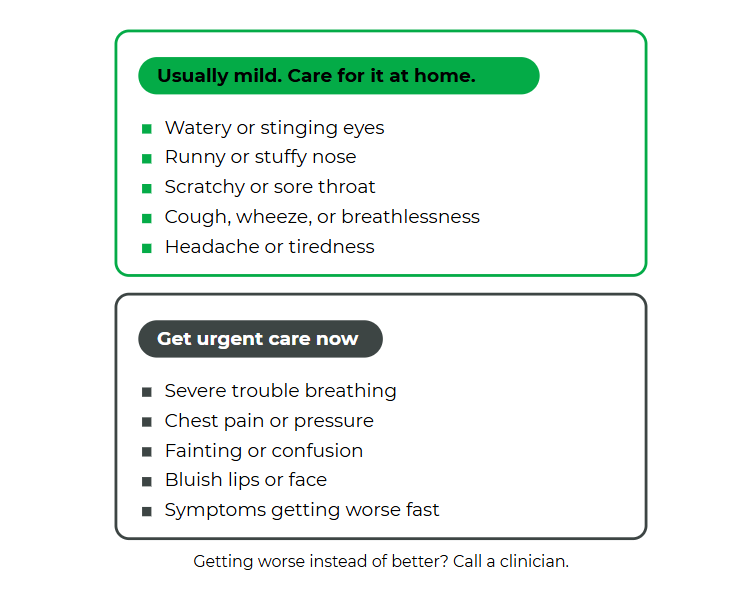
Infographic showing the quick recovery guide including questions and next steps when inhaling mild smoke.

"After helping more than two million households navigate air quality concerns—including major wildfire seasons—we've learned that most people stop worrying once they can't smell smoke anymore. But the microscopic particles causing respiratory symptoms are completely invisible, and our testing shows they remain trapped in HVAC systems and soft surfaces for days after the odor fades. Addressing what you can't see is what actually accelerates recovery."

— Filterbuy Air Quality Team

Essential Resources for Understanding Mild Smoke Inhalation Symptoms

Don't take your indoor air for granted—especially when smoke is involved. At Filterbuy, we're obsessed with helping you protect your greatest assets: your family, your home, and your HVAC system. After working with over two million households and manufacturing filters for more than a decade, we've seen firsthand how smoke exposure catches families off guard.

The truth? Most people don't realize how smoke affects their health until symptoms appear. That's why we've gathered the most trusted resources to help you recognize warning signs, understand your risks, and take action with confidence. Because you're the hero of your household—and heroes need the right information.

Recognize Symptoms and Know When to Worry

Cleveland Clinic – Smoke Inhalation Guide

Here's something that might surprise you: smoke inhalation symptoms range from mild throat irritation to serious breathing problems, and knowing the difference matters. This guide from the Cleveland Clinic breaks down exactly what to watch for and when home care is enough versus when you need professional help. Bonus: they cover HEPA filtration strategies we recommend to our customers every wildfire season.

Understand Who Faces the Highest Risk

CDC – How Wildfire Smoke Affects Your Body

We can't see all the pollutants floating through our homes—but they affect some family members more than others. The CDC identifies who's most vulnerable: children, pregnant women, elderly family members, and anyone with asthma, COPD, or heart conditions. If someone in your household falls into these categories, this resource helps you understand why extra protection matters.

Learn First Aid Steps and Emergency Warning Signs

WebMD – Smoke Inhalation Treatment & First Aid

When smoke exposure happens, you need to know exactly what to do—not scramble for answers. WebMD provides clear, actionable steps: what symptoms mean "watch and wait" versus "call 911 now," how to help someone while waiting for emergency responders, and what realistic recovery looks like. This is the kind of practical guidance that empowers you to act decisively when your family needs you most.

Know Why Symptoms Can Appear Hours Later

Merck Manual – Smoke Inhalation

Here's a fact we wish more homeowners knew: smoke inhalation symptoms can develop up to 24 hours after exposure. That means feeling fine right after a smoke event doesn't guarantee you're in the clear. The Merck Manual explains why delayed symptoms happen and covers the sneaky signs of carbon monoxide exposure—headache, nausea, confusion—that too many people dismiss as "just a bad day."

Discover Why Even Mild Cases Deserve Attention

Medical News Today – Smoke Inhalation Causes & Treatment

We've talked with countless customers who assumed mild coughing or scratchy throat after smoke exposure was "no big deal." But here's what the experts say: even mild smoke inhalation often benefits from professional evaluation, especially if you have underlying respiratory conditions. This resource helps you understand why taking symptoms seriously—even small ones—protects your long-term health.

Find Guidance on Home Observation vs. Emergency Care

eMedicineHealth – Smoke Inhalation Signs & Recovery

Not every smoke exposure requires an emergency room visit—but knowing the difference is critical. This guide provides specific criteria for when home monitoring makes sense and when medical evaluation is non-negotiable. It also covers recovery expectations and what triggers to avoid while your lungs heal, so you can support your body's natural healing process.

Understand Why Smoke Inhalation Is Called the "Silent" Danger

MedStar Health Burn Center – Fire's Quiet Killer

Burn center specialists call smoke inhalation "fire's quiet killer" for a reason: the damage often isn't visible, and symptoms can seem minor until they're not. This expert perspective reinforces something we tell our customers regularly—when it comes to smoke exposure, what you can't see can absolutely hurt you. Even if you feel fine after exposure, understanding this risk helps you make smarter decisions for your family.

Pro Tip: After more than a decade helping families breathe easier, we've learned that preparation beats panic every time. Bookmark these resources before wildfire season hits or whenever air quality alerts pop up in your area. Pair this knowledge with proper HVAC filtration—MERV 13 filters capture the fine particles that make smoke so dangerous—and you'll be ready to protect your household like the family hero you are.

Because at Filterbuy, we believe better air starts with better information. And now you have both.

Supporting Statistics: Why Indoor Air Protection Matters

After manufacturing air filters for over a decade and serving more than two million households, we've seen how often families underestimate smoke's invisible dangers.

The numbers confirm what we observe every wildfire season:

Smoke Inhalation Fatality Rates

Respiratory Impact Data

Indoor Air Quality Reality

Final Thought: What We've Learned From Two Million Households

After more than a decade manufacturing air filters and helping families recover from smoke events, we've developed a perspective most medical resources don't address: the recovery doesn't end when symptoms disappear.

The mistake we see most often: People treat smoke inhalation as a single event rather than an ongoing exposure risk.

The smoke you inhaled yesterday isn't the only problem. Particles settle into carpets, furniture, and ductwork—then recirculate every time your HVAC system kicks on. We've spoken with thousands of customers who felt fine for weeks, only to notice unexplained congestion, headaches, or throat irritation. The culprit? Indoor air still contaminated long after visible smoke cleared.

Our honest opinion: The 48–72 hour symptom window is accurate for acute effects. But true recovery—especially for households with children, elderly family members, or respiratory sensitivities—requires addressing air quality for weeks, sometimes months.

What we wish more people understood:

  1. Your nose adapts faster than your lungs heal. You may not smell smoke anymore, but particulates can still be present. We've tested "completely clear" homes with PM2.5 levels still elevated weeks post-exposure.
  2. Standard filters weren't designed for smoke recovery. Most homes run MERV 8 or lower—adequate for everyday dust, ineffective against fine smoke particles. MERV 13 during and after smoke events isn't overcautious; it's appropriate.
  3. Trust your instincts. If something feels off about your indoor air, you're probably right. Families who take air quality seriously—running filters continuously, replacing them frequently, ventilating strategically—report faster, more complete recoveries.

The bottom line:

Mild smoke inhalation is recoverable for most healthy adults. But "recoverable" and "optimal" aren't the same thing.

You deserve air that supports your health—not air that's merely "good enough." That conviction has driven our obsession with indoor air quality since we manufactured our first filter in 2013.

Your home should be a sanctuary. After smoke exposure, restoring it takes intentional effort. The good news? With the right knowledge and tools, you're fully capable of protecting your family's air.

Next Steps: Your Smoke Recovery Action Plan

You have the knowledge. Now put it into action.

Immediate Actions (Within 24 Hours)

  1. Assess your symptoms. Review warning signs above. Chest pain, difficulty breathing, confusion, or worsening symptoms = seek medical attention immediately.
  2. Check your air filter. Visibly dirty or post-smoke exposure? Replace it now. Clogged filters recirculate the particles you're trying to remove.
  3. Ventilate if safe. Outdoor AQI below 100? Open windows and run exhaust fans for 15–30 minutes.

Short-Term Recovery (Days 1–7)

Long-Term Protection (Ongoing)

FAQ on "Mild Smoke Inhalation Symptoms"

Q: What are the most common symptoms of mild smoke inhalation?

A: The most common symptoms include:

Symptoms typically appear within minutes to hours after exposure. What we've learned from serving over two million households: many people dismiss early symptoms as allergies or a cold—especially during wildfire season. If these symptoms cluster together after smoke exposure, trust what your body is telling you.

Q: How long do mild smoke inhalation symptoms last?

A: Typical recovery timeline:

What most resources don't mention: symptom duration depends as much on your recovery environment as on initial exposure. Our observation from customer conversations: those who address indoor air quality—upgrading filters, ventilating, cleaning surfaces—report faster resolution than those who focus only on rest.

When to seek help: Symptoms persisting beyond 72 hours or worsening at any point.

Q: When should I go to the hospital for smoke inhalation?

A: Seek emergency care immediately for:

Important insight from customer experience: People tend to underestimate delayed symptoms. We've heard from families who felt fine initially, then developed breathing difficulties 12–24 hours later. Smoke damage isn't always immediately apparent. When in doubt, get evaluated.

Q: Can I treat mild smoke inhalation at home?

A: Yes. Most mild cases respond well to home care.

Immediate treatment steps:

  1. Move to fresh air
  2. Rest your respiratory system
  3. Stay hydrated with water and warm fluids
  4. Monitor symptoms closely

What we wish more people understood: Treating your body is only half the equation. Smoke particles settle into carpets, furniture, and ductwork—continuing exposure during recovery.

Address your environment:

Your home should support healing, not prolong exposure.

Q: How do I know if smoke inhalation is mild or severe?

A: Key differences:

Mild smoke inhalation:

Severe smoke inhalation:

Our perspective from years of customer conversations: The line between mild and severe isn't always obvious. We've spoken with people who assumed symptoms were minor, only to need medical intervention.

Bottom line: If your gut says something isn't right, listen to it. A medical evaluation for "just mild symptoms" is never wasted—it's peace of mind at minimum from filter, potentially life-saving at maximum.

Protect Your Recovery With Cleaner Indoor Air

Now that you know how to recognize mild smoke inhalation symptoms and treat them safely, take the next step by upgrading to MERV 13 filtration—capturing the fine particles that standard filters miss. Find your filter size at Filterbuy.com and start breathing easier today.