Shop by
August 4, 2026
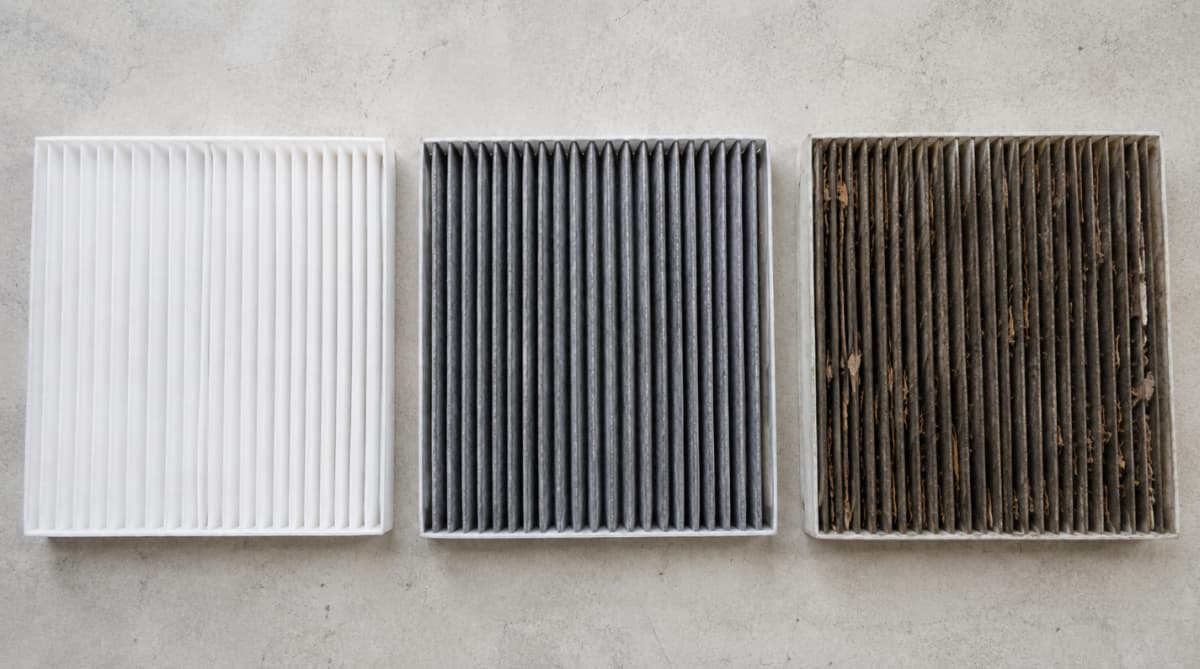
By Michelle Wan, Brand Manager and Air Quality Writer. Reviewed for technical accuracy by David Clark, Licensed HVAC Technician. August 5, 2026. August 5, 2026.
No cabin air filter brand is best for every driver, because no independent body in the U.S. certifies cabin filter performance. MERV is a home HVAC rating, and any brand can print “HEPA-grade” on a box with no third-party check behind it. Two lab standards do exist — ISO/TS 11155-1 for particles and ISO 11155-2 for odors and gases — but few retail brands publish results against either. So judge the label, not the logo.
The brands worth your money come from three lineages:
Original-equipment suppliers — Corteco/micronAir, MANN-FILTER, MAHLE, Denso, Bosch. Built to automaker specs.
Automaker parts brands — Motorcraft, ACDelco, Mopar. Guaranteed fit, highest price.
Direct-to-consumer — Filterbuy, PUREFLOW, EPAuto. Cost and reorder convenience.
Lineage tells you who built it, not how it ranks. Run the four-signal check on any brand, ours included, then confirm fitment.
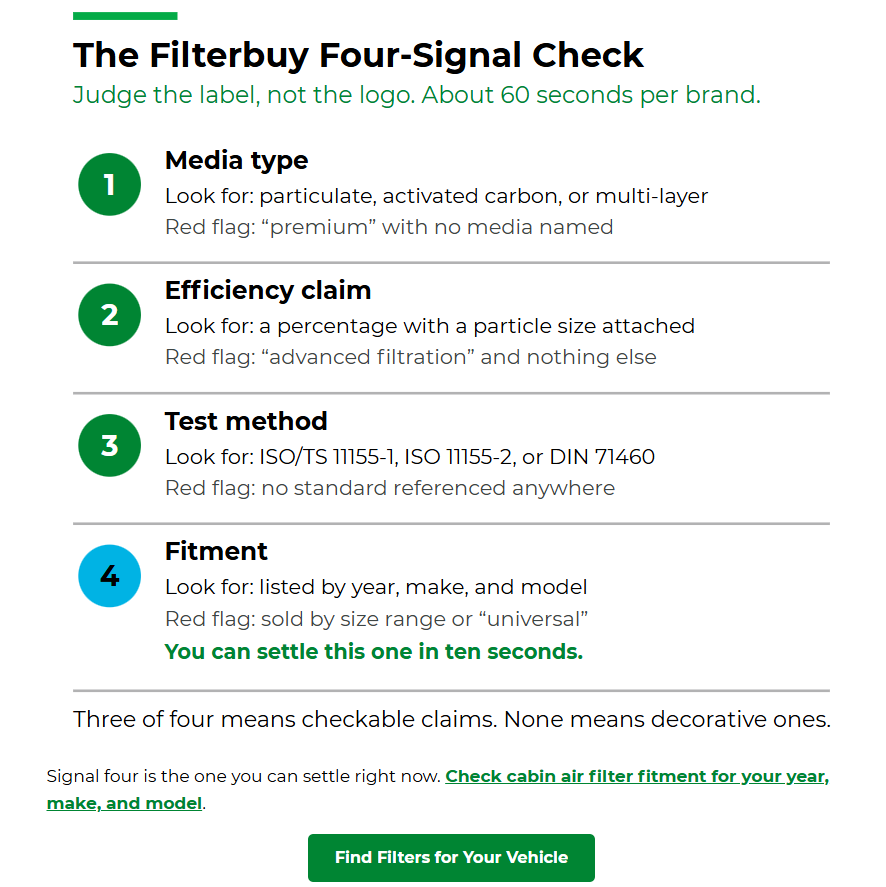
Not sure which media type your driving calls for? Answer a few quick questions and we’ll match you to the right filter.
No cabin air filter brand is best for every driver, because no independent body certifies cabin filter performance in the U.S. The brands worth your money fall into three groups: original-equipment suppliers like Corteco/micronAir, MANN-FILTER, MAHLE, Denso and Bosch; dealer OEM parts; and direct-to-consumer brands. Run the four-signal check on any of them, ours included, then confirm fitment.
Cabin air filters have no mandatory efficiency rating in the U.S. MERV is a home HVAC rating. Any brand can print "HEPA-grade" with no third-party check.
Two published lab standards exist. ISO/TS 11155-1 measures particulate filtration and pressure loss. ISO 11155-2 covers odors and gases. Few retail brands publish results against either.
Freudenberg Filtration Technologies invented the cabin air filter in 1989, for the Mercedes-Benz SL. Its micronAir line reaches the aftermarket through Corteco.
A filter that does not seal lets air bypass it. Fitment beats a higher efficiency claim in a loose frame.
Only activated carbon addresses odors and gases. Particle efficiency does nothing for exhaust smell.
Working on the manufacturing side teaches you fast what a spec sheet does and does not prove, and how little of it anyone outside the building ever checks.
The honest answer to "which brand is best" is that the question has no verifiable answer. That is a fact about the category, not a dodge. Home air filters carry a MERV rating defined by ANSI/ASHRAE Standard 52.2. Respirators carry NIOSH certification. Cabin air filters carry neither. No U.S. regulation requires one to meet a stated efficiency, and no independent body audits the claims on the box.
Two test methods do exist. ISO/TS 11155-1 covers efficiency, pressure loss, and dust-holding capacity above 0.3 microns. ISO 11155-2 covers odors and vapors. Manufacturers use both internally. Almost none publish results a shopper can read.
So two filters can both claim 99.97% at 0.3 microns when one was measured in a sealed duct, and the other on a sample nobody outside the company has seen.
Before you compare brands, compare labels. This is the check Filterbuy uses internally. It separates a falsifiable claim from a decorative one.
A brand clearing three of four signals is making specific, checkable claims. A brand clearing none is selling a picture of a pleated rectangle.
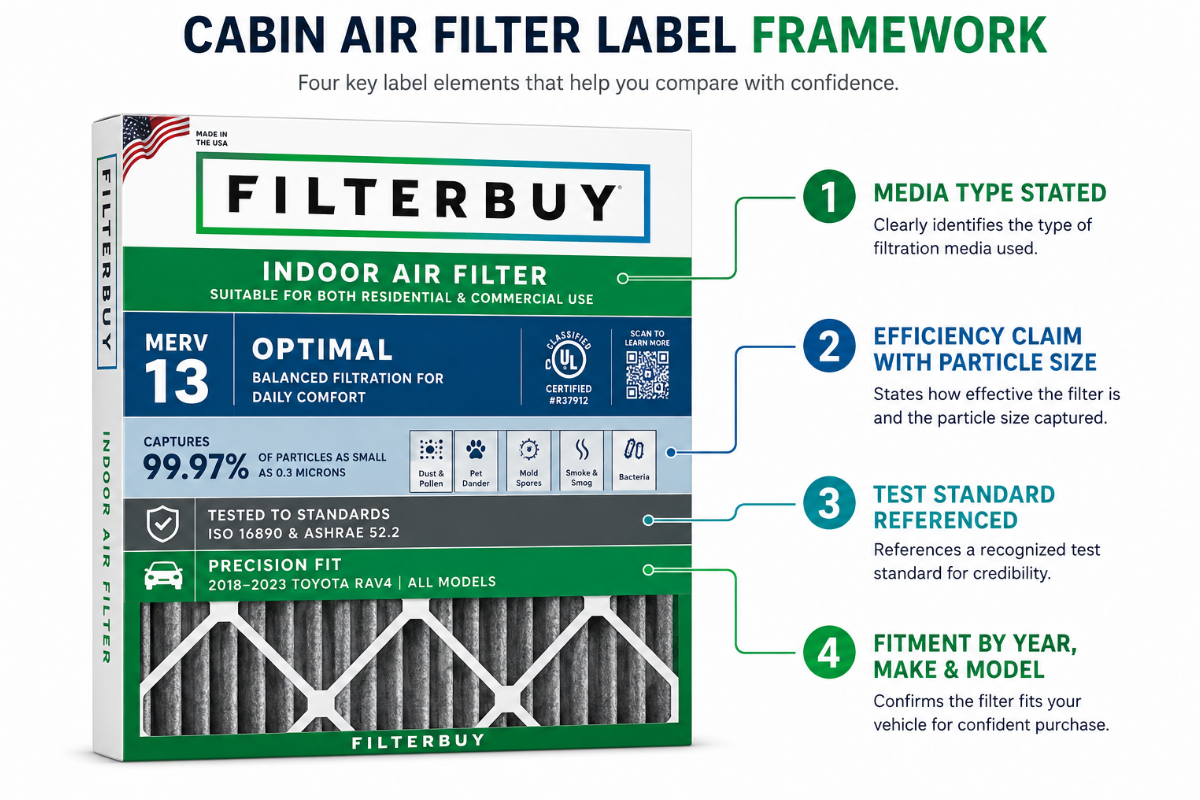
Know your vehicle already? Check cabin air filter fitment for your year, make, and model. Signal four is the one you can settle in about ten seconds.
Most aftermarket brands come from one of three lineages, and which one tells you more than any star rating.
Lineage reflects the manufacturer behind the brand, not a performance ranking. Verify current OE supply relationships before relying on them.
Brand matters less than matching media to conditions.
Media type drives the outcome here. Brand name does not.
Every page on this topic tells you to weigh price against performance, and none of them shows you the numbers. Here they are. Advance Auto Parts lists its best-selling cabin air filters between $15.49 and $42.99. That is the entire spread across brands, media types and lineages. Changed once a year, the gap between the cheapest sensible filter and the best one on the shelf is about twenty-seven dollars.
Which means price is the wrong thing to optimize. Twenty-seven dollars a year is roughly one tank of gas. Spend the decision on fit and media instead, and put whatever you save toward changing the filter on schedule rather than stretching it a second year.
A dealer OEM filter buys certainty of fit and nothing else. Most come from the same Tier 1 suppliers that sell under their own names (Freudenberg, MANN+HUMMEL, MAHLE, Denso, Bosch), so the aftermarket part and the dealer part often leave the same line at two to four times the price. Buy OEM when fitment is unusual.
We manufacture cabin air filters and compete with several brands above, so run the Filterbuy Four-Signal Check against Filterbuy rather than taking our word for it.
Three of four beats most of the market and is short of perfect. Our 99.97% figure is a manufacturer claim, not a published ISO/TS 11155-1 result. Read it that way until we publish one.
What we separate on is confirmable before you buy: made in the USA, factory-direct without the dealer markup, listed by year, make, and model, available in multipacks with scheduled delivery. If an OE-lineage brand clears more signals for your vehicle, buy that one.
Find the cabin air filter that fits your vehicle, or read the complete buyer’s guide to cabin air filters first.
Nobody selling filters leads with this. Four limits worth knowing before you overspend.
Carbon runs out before the filter looks dirty. The carbon layer adsorbs odors until it saturates, then quits, while the particulate layer keeps catching dust. A filter that still looks fine may have stopped doing what you bought it for.
Nothing works with a window down. The filter only cleans air pulled through the climate system. Crack a window and you have bypassed it.
No cabin filter handles carbon dioxide. Carbon adsorbs odors and some gases. It does nothing about the CO2 you and your passengers breathe out.
Review counts measure distribution, not filtration. Reviewers can report fit. They can report airflow and smell. None can measure efficiency.
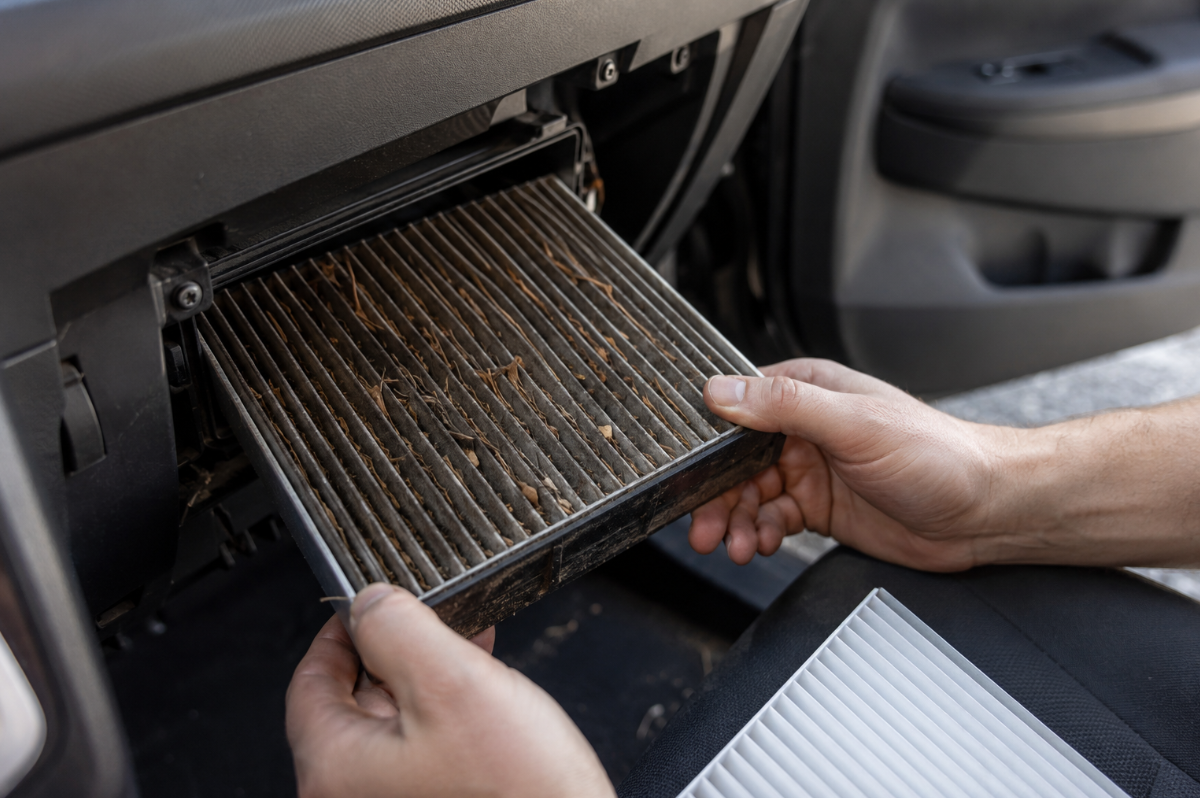
On a bad-air day the recirculate button does more for you than a filter upgrade does. EPA guidance is to close the windows and run the air conditioner in recirculate mode. In most vehicles that recirculated air still passes through the cabin filter, so you are re-cleaning interior air instead of drawing fresh smoke in. EPA also says to slow down when smoke limits visibility. Switch back to fresh air once it clears, and use defrost if the windows fog.
Filterbuy sells filters and would still rather you skip the premium one here.
Rural routes, low pollen, no allergies in the car. A standard filter changed on time is enough.
Your filter is under a year old and airflow is normal. Changing early buys you nothing.
Choosing between a premium filter you forget for three years and a basic one you change annually. Take the basic one. Schedule beats media every time.
Every claim traces to a primary source: the ISO abstracts for both cabin filter test standards, the EPA definitions of HEPA and MERV, and the technical literature Freudenberg and Corteco publish. Where a brand states an efficiency figure with no published test behind it, we say so. Ours included.
Six of these seven don’t sell filters, and that’s on purpose. Nobody audits the claims printed on a filter box, so it’s worth a few minutes with sources that don’t care which brand you pick.
See What That 99.97% Claim Was Actually Tested Against
Source: ISO/TS 11155-1: Test for particulate filtration (International Organization for Standardization)
This is the lab test a real efficiency number should come from. It checks three things that matter: how much a filter catches, how much airflow it costs you, and how much dirt it holds before it quits.
Make Sure a Carbon Filter Was Tested for Smells, Not Just Dust
Source: ISO 11155-2: Test for gaseous filtration (International Organization for Standardization)
Dust testing tells you nothing about odors. This is the separate test for gases and smells, which is the whole thing you’re paying extra for when you buy activated carbon.
Find Out What "HEPA-Grade" Really Promises You
Source: What is a HEPA filter? (U.S. Environmental Protection Agency)
HEPA has a real definition: 99.97% of particles at 0.3 microns, which is the hardest size to catch. Two minutes here will tell you how much weight that word deserves on a cabin filter box.
Understand Why MERV Doesn’t Belong on a Cabin Filter
Source: What is a MERV rating? (U.S. Environmental Protection Agency)
You know MERV from your home furnace filter, and that’s exactly the problem. The EPA lays out what the scale measures and why it was built for HVAC systems rather than cars.
Learn the Three Filter Types From the People Who Invented Them
Source: micronAir cabin air filters (Freudenberg Filtration Technologies)
Freudenberg built the first cabin air filter in 1989, and they explain the media better than anyone selling it. Start here if you want to know what’s actually inside a particle, combi, or four-layer filter.
Check Whether You Actually Need Carbon Where You Drive
Source: AirNow Fire and Smoke Map (U.S. EPA and U.S. Forest Service)
Pull up your area and see the real particle levels on the roads you use. If smoke and traffic show up, carbon earns its keep. If they don’t, a standard filter is plenty.
Find the Exact Filter Your Car Takes
Source: Cabin air filter fitment by vehicle (Filterbuy)
Enter your year, make, and model and get the filter that fits, instead of guessing from a size chart. Check it against the part number in your owner’s manual before you order from us or anybody else.
Three numbers, and what each means for your filter.
More than 45 million Americans live within 300 feet of a busy road, rail yard, or airport.
Why it matters: Exhaust, brake dust and tire particles concentrate there.
What to buy: activated carbon.
Source: U.S. EPA, Near Roadway Air Pollution research (June 2026)
25.2% of U.S. adults had a diagnosed seasonal allergy in 2024.
Why it matters: One in four drivers reacts to what a cabin filter catches.
What to buy: high-efficiency or multi-layer media.
44% of Americans, 152.3 million people, live in counties failing ozone or particle standards.
Why it matters: Nearly half the country drives through air that fails a standard.
What to buy: check your county first, then match the media.
No brand is best for every vehicle, because no U.S. body certifies cabin filter performance. Original-equipment suppliers (Corteco/micronAir, MANN-FILTER, MAHLE, Denso, Bosch) are the safest default, built to automaker specs. Direct-to-consumer brands like Filterbuy compete on cost and confirmed fitment. Match media to your conditions, then confirm fitment.
Sometimes. Price tracks media complexity and sales channel more than measured performance. Our breakdown of cheap versus quality cabin air filters covers where the savings become real trade-offs.
No. MERV is defined by ANSI/ASHRAE Standard 52.2 for home HVAC filters. Cabin filters are tested under ISO/TS 11155-1 and ISO 11155-2, though few brands publish results.
Different jobs. High-efficiency media captures fine particles: pollen, dust, smoke. Carbon adsorbs odors and gases. A multi-layer filter doing both is better for city driving or wildfire smoke.
Choose by media, not brand. A high-efficiency or multi-layer filter from any OE-lineage brand beats a basic filter from a premium one. Fit matters equally, since bypass air carries pollen straight past the media.
Every 12 months or 12,000 miles, sooner in dust, pollen, or smoke. Weak airflow, musty odors, and slow defogging are the signs. See how often to change a cabin air filter for intervals, or how to replace a cabin air filter for the ten-minute walkthrough.
Michelle Wan is Brand Manager and Air Quality Writer at Filterbuy, where she translates filtration, MERV ratings, and HVAC efficiency into plain-English guidance for homeowners and drivers (B.A., University of California, Santa Cruz). This guide was reviewed for technical accuracy by David Clark, Licensed HVAC Technician. Filterbuy has manufactured air filters in the USA since 2013, with factories in Alabama, Florida, Pennsylvania, and Utah.
Cabin air filter: a pleated filter in the HVAC intake that cleans air before it reaches the vents. It does not filter engine air (see cabin air filter vs. engine air filter).
Activated carbon: a treated layer that adsorbs odors and gases, not particles.
Bypass air: unfiltered air that slips around a badly fitting filter instead of through the media.
ISO/TS 11155-1: the international laboratory test method for particulate efficiency, pressure loss and dust-holding capacity. Published 2001, confirmed current 2024.
ISO 11155-2: the international laboratory test method for gas and odor filtration. Published 2009, confirmed current 2023.
MERV: Minimum Efficiency Reporting Value, defined by ANSI/ASHRAE Standard 52.2 for home HVAC filters. Not an automotive rating.
OE / OEM: original equipment. An OE supplier builds parts fitted at the factory; an OEM part carries the automaker’s brand.
Pressure drop: the airflow resistance a filter adds. More resistance means weaker vents and a harder-working blower.
