Shop by
June 29, 2026

Author: Michelle Wan
Reviewed by: David Clark, Licensed HVAC Technician
Published / Updated: June 30, 2026
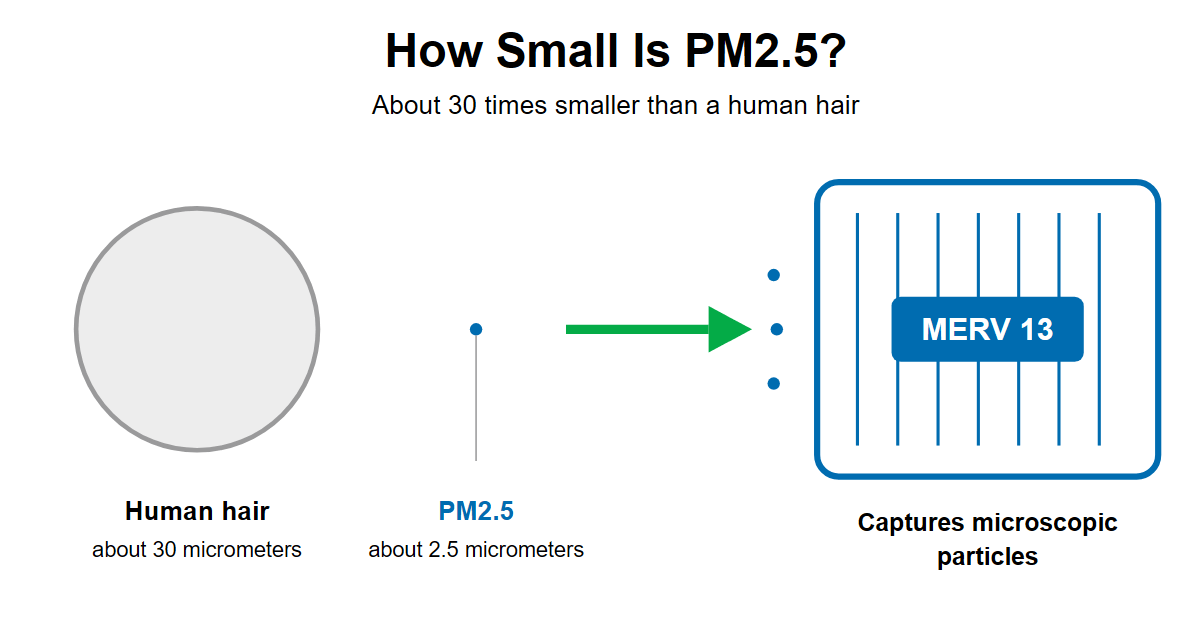
Yes — breathing polluted air can make you sick. Tiny particles called PM2.5 slip past your body’s defenses and reach deep into your lungs, which can set off coughing, irritated eyes, headaches, and far more serious effects for children, older adults, and anyone with a heart or lung condition. You control your indoor air, though. Seal the house, run your HVAC fan, and fit a MERV 13 filter that captures these microscopic particles. Use the options below to get set up.
Considering a ductless mini split for better-controlled, better-filtered indoor air? Answer a few quick questions and we’ll help you find the right system.
Most homeowners notice the haze outside or a scratchy throat indoors and assume the two have nothing to do with each other. They do. When wildfire smoke drifts across a county or summer smog settles over a city, the same fine particles that dim the skyline travel into your lungs, and for a lot of people, they set off real, measurable illness. At Filterbuy, we spend our days obsessed with what floats through American homes, and the honest answer to the question in the headline is yes. Breathing polluted air can make you sick; the effects run from a mild cough to a hospital visit, and the people in your household who feel it first are often the ones you most want to protect.
The reassuring part is that you control far more of your indoor air than most people realize. Once you know which symptoms to watch, who faces the highest risk, and which indoor moves actually work, a bad-air day becomes something you manage rather than something that manages you.
Yes, bad air quality can make you sick. Fine particle pollution (PM2.5) and ground-level ozone irritate the eyes, nose, throat, and lungs, set off coughing and wheezing, and can trigger asthma attacks, heart attacks, and strokes in vulnerable people. Children, older adults, pregnant people, and anyone with heart or lung disease face the highest risk. Filtering the air inside your home sharply lowers what you actually breathe.
Can healthy people get symptoms? Yes. Even healthy adults can develop coughing, headaches, eye irritation, and fatigue during high-pollution or wildfire-smoke days.
Which pollutant matters most indoors? PM2.5, fine particles small enough to reach deep lung tissue and pass into the bloodstream.
What is the single most effective indoor step? Run your HVAC system continuously with a high-efficiency MERV 13 filter and add a properly sized portable air cleaner.
Poor air quality is a documented health threat, not just an allergy nuisance. The American Lung Association reported that 152.3 million people in the United States lived in counties with failing air-quality grades in its 2026 "State of the Air" report.
PM2.5 is the main driver of pollution-related illness because the particles travel deep into the lungs and can enter the bloodstream.
Symptoms range from short-term irritation such as coughing, wheezing, watery eyes, and headache to serious events such as asthma attacks, heart attacks, and strokes, plus long-term disease.
Sensitive groups feel the effects first: children, older adults, pregnant people, and anyone with asthma, COPD, heart disease, or diabetes.
The Air Quality Index (AQI) tells you when to act. Orange (101 to 150) flags risk for sensitive groups, and red and above flag risk for everyone.
You can cut indoor exposure a great deal by sealing the home, upgrading HVAC filtration to MERV 13, and running a portable air cleaner.
Bad air quality makes you sick because the pollutants in it are small enough to bypass your body’s natural defenses. The biggest culprit is PM2.5, fine particles measuring 2.5 micrometers or less, roughly thirty times smaller than a human hair. The U.S. Environmental Protection Agency reports that these particles reach deep into the lungs, and some pass into the bloodstream, where they can affect both the heart and the lungs. Ground-level ozone, the main ingredient in smog, adds a second layer of irritation that the American Lung Association compares to a sunburn inside your airways.
Wildfire smoke deserves special attention. Research published in Nature Communications found that the PM2.5 in wildfire smoke appears to be more damaging to the lungs than the same amount of particle pollution from other sources. That matters for millions of households downwind of fires, because smoke can travel hundreds of miles from where it starts.
The symptoms of breathing polluted air usually start within hours and affect the eyes, nose, throat, and chest first. Most people notice irritation, coughing, and shortness of breath on a bad-air day, and those with asthma or heart conditions can experience far more serious reactions. The table below maps the most common symptoms to when they tend to appear and the pollutant most often behind them.
When to get help: Seek medical care if you have trouble breathing, a cough that will not stop, chest pain, or symptoms that do not improve when you get to cleaner air. Call 911 for any medical emergency.
The people most at risk from bad air quality are children, older adults, pregnant people, and anyone with a heart or lung condition. These groups either breathe more air for their body size, have airways and hearts that are more reactive, or carry conditions that pollution can push over the edge. Everyone can get sick on a high-pollution day, but these households should act earlier and watch more closely.

The Air Quality Index, or AQI, is the fastest way to know when bad air can make you sick. Run by the EPA through AirNow, the AQI converts pollution levels into a 0 to 500 scale with six color-coded categories. A reading at or below 100 is generally satisfactory. Once the number climbs above 100, the air turns unhealthy first for sensitive groups and then, as it rises, for everyone. When wildfires are driving the numbers, our guide on how to read a wildfire smoke map shows how to check live conditions for your exact address.
The most effective way to reduce exposure on a bad-air day is to seal your home and filter the air inside it. Indoor PM2.5 typically runs around 55 to 60 percent of outdoor levels when windows and doors stay closed, and good filtration drives that number lower. Work through the steps below in order, starting before the smoke or smog arrives if you can.
Check the AQI first. Look up your local conditions at AirNow before you decide how aggressively to act, and check again as the day changes.
Seal the home. Close windows and doors, set your HVAC system to recirculate, and close any fresh-air intake so you are not pulling outdoor air in. For the full room-by-room walkthrough, see our steps to keep wildfire smoke out of your house.
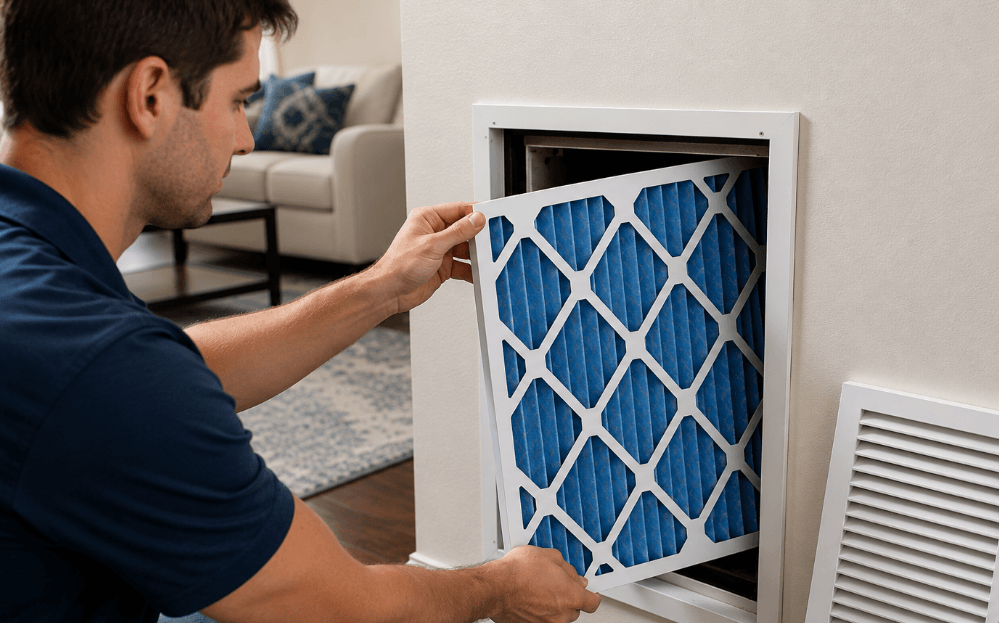
Upgrade your HVAC air filter to a high-efficiency MERV 13 model. The EPA recommends MERV 13 or higher to capture the very small particles in smoke. We build MERV 13 filters in the USA in more than 600 sizes, and if you are unsure what your system can safely run, our guide on which MERV rating to choose walks through it.
Run the system fan continuously. Set the thermostat fan to "On" rather than "Auto" so air keeps cycling through the filter even when heating or cooling is not running.
Add a portable air cleaner. Choose a HEPA unit sized for the room that does not produce ozone, or build a DIY box-fan filter when a commercial unit is not available or affordable.
Create a clean room. Pick one room you can close off, run the air cleaner there, and keep the door shut to hold a pocket of cleaner air for sensitive household members.
Stop adding indoor particles. Avoid smoking and vaping, frying or broiling food, burning candles or incense, using wood-burning stoves, spraying aerosols, and vacuuming without a HEPA filter.
Change filters more often. During a smoke event, check your HVAC and air-cleaner filters frequently and replace them as soon as they look dirty, because a loaded filter stops working well.
Mask up if you must go out. A well-fitted N95 respirator filters smoke particles, while cloth and surgical masks do not.
Quick Reference: Match Your Action To The AQI Color
We built this simple ladder so you can decide what to do at a glance, based on the color showing on AirNow or your weather app.
“After manufacturing filters for over a decade and serving more than two million households, we’ve learned that the families who stay healthiest on bad-air days treat their HVAC system as their first line of defense. A clean, high-efficiency filter running continuously does more for your indoor air than almost anything else you can do at home.”
David Heacock, Founder and CEO, Filterbuy
These independent, authoritative sources back up the guidance on this page. Each comes from a separate government or nonprofit health authority.
A plain-science explanation of how PM2.5 and PM10 affect the body and which groups are hit hardest. Source: California Air Resources Board overview of particulate matter and health.
The official EPA breakdown of the six AQI categories and what each color means for your health. Source: AirNow guide to Air Quality Index basics.
Who faces a higher risk from smoke and how to protect children, older adults, and people with chronic conditions. Source: CDC guidance on wildfires and your safety.
How particle pollution can trigger heart attacks, strokes, and arrhythmias in susceptible people. Source: American Heart Association on air pollution, heart disease, and stroke.
Why pollution worsens asthma symptoms and can contribute to developing the disease. Source: Asthma and Allergy Foundation of America on air pollution and asthma.
Step-by-step directions for setting up a low-smoke room, including the MERV 13 recommendation. Source: EPA instructions for creating a clean room during a wildfire.
A trusted plain-language overview of air pollution and its health effects from the National Library of Medicine. Source: MedlinePlus air pollution health topic.
Wildfire-specific PM2.5 was associated with increases in respiratory hospitalizations of 1.3% to 10% for every 10 micrograms per cubic meter, compared with 0.67% to 1.3% for particle pollution from other sources.
Source: Aguilera et al., Nature Communications (2021)
152.3 million people in the United States, about 44% of the population, live in counties with failing grades for ozone or particle pollution.
Source: American Lung Association, "State of the Air" 2026 key findings
Long-term exposure to PM2.5 contributed to more than 4 million deaths worldwide in 2019.
Source: Health Effects Institute, State of Global Air
Here is what we believe after years of building filters for American families. Air pollution gets treated as a problem you can only wait out, something the weather inflicts on you. We see it differently. The air outside is out of your hands, but the air your family actually breathes for the eight or more hours they spend at home is something you can change today. That shift, from feeling exposed to feeling in control, is the whole point of paying attention to this topic.
Our strong opinion is that filtration is the most overlooked health tool in the average home. People buy supplements and fitness trackers and still ignore the one system that processes every cubic foot of air in the house. A MERV 13 filter and a continuously running fan are not glamorous, and they work. On the days the sky turns orange, the families who prepared are the ones breathing easy.
Bookmark AirNow and check it whenever the air looks or smells off, especially during fire and smog season.
Confirm your filter size and upgrade to MERV 13 before the next bad-air day, then keep a spare on hand.
Set up a clean room and test your portable air cleaner now, so it is ready when you need it. When you are ready to upgrade your filter, we can help you find the right filter for your system.
A: Yes. Healthy adults can develop coughing, eye and throat irritation, headaches, shortness of breath, and fatigue during high-pollution or wildfire-smoke days. The effects are usually short-lived for healthy people, but repeated exposure over time still raises the risk of heart and lung disease.
A: The earliest signs are usually irritation of the eyes, nose, and throat, along with coughing, a runny nose, and shortness of breath. Headache and fatigue are common with wildfire smoke. People with asthma may notice tightness or more inhaler use within hours.
A: Children, older adults, pregnant people, and anyone with asthma, COPD, heart disease, or diabetes face the highest risk. Outdoor workers are also exposed for longer at higher breathing rates. These groups should act earlier and watch their symptoms more closely.
A: Check the Air Quality Index at AirNow or in your weather app. A reading of 101 to 150 (orange) is risky for sensitive groups, 151 to 200 (red) affects everyone, and anything above 200 (purple or maroon) is a health alert for the whole household.
A: Yes, when it is set up correctly. Keep windows and doors closed, set the system to recirculate, close any fresh-air intake, run the fan continuously, and use a high-efficiency MERV 13 filter. This setup pulls fine smoke particles out of the air your family breathes.
A: MERV 13 is the rating the EPA recommends for capturing the very small particles in wildfire smoke. Confirm your system can handle a MERV 13 filter, then replace it more often than usual during a smoke event because it will load up faster.
A: For most healthy people, symptoms ease within hours to a day or two after the air clears and exposure stops. If you have a heart or lung condition, symptoms can last longer or turn serious, so seek medical care if breathing trouble, chest pain, or a persistent cough does not improve.
A: A high-efficiency filter rated MERV 13 or higher, running in a sealed home, captures a large share of the fine smoke particles that cause symptoms. Pairing it with a properly sized HEPA portable air cleaner in a clean room gives sensitive household members the cleanest air available indoors. For a deeper comparison, see our breakdown of the best MERV filter for wildfire smoke.
You cannot control the smoke or the smog outside, but you can control what your family breathes indoors. The next bad-air day is coming, and a clean MERV 13 filter is the simplest way to be ready for it. Take a minute now to check your filter size, upgrade to high-efficiency filtration, and breathe easier when the sky turns hazy.
Protect your home today. Shop Filterbuy MERV 13 filters built in the USA.
