Shop by
August 21, 2026
By Michelle Wan, Air Quality Writer at Filterbuy · Reviewed by David Clark, Licensed HVAC Technician, Filterbuy HVAC Solutions · Published August 21, 2026
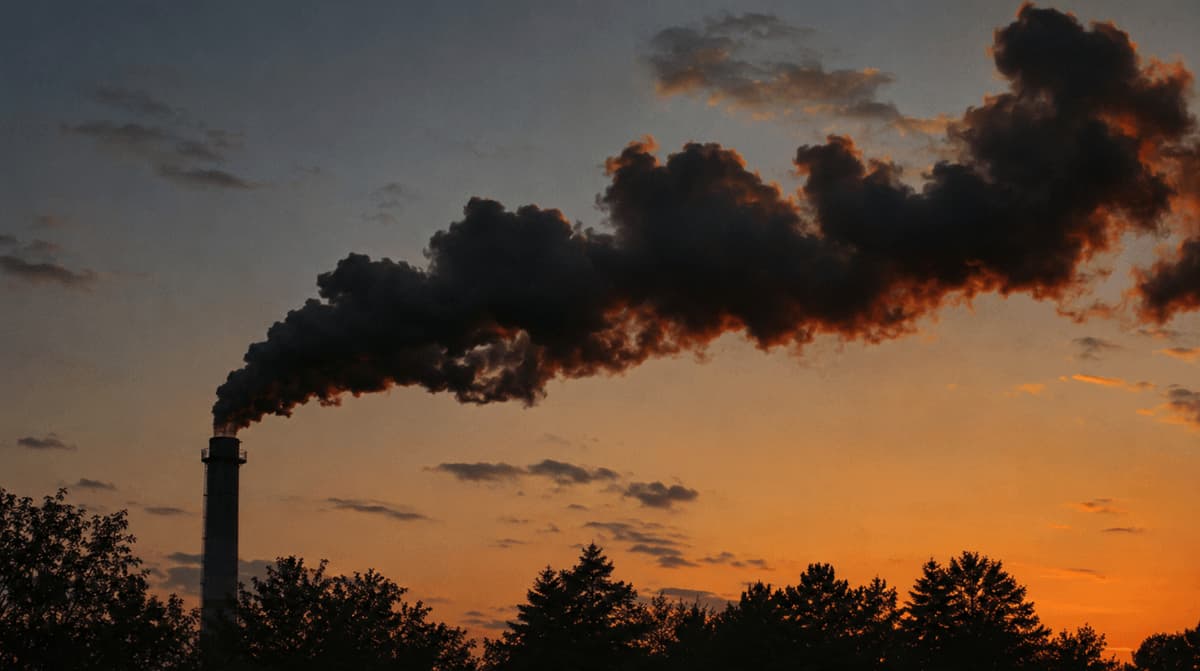
Black carbon is the elemental carbon in soot, the part of PM2.5 that comes from diesel engines, wood stoves, and wildfires. Per microgram inhaled, research associates it with larger health effects than PM2.5 measured as undifferentiated mass. A 2011 systematic review by Janssen and colleagues reported that pattern against both PM2.5 and PM10. No AQI app breaks black carbon out, so it stays folded inside the PM2.5 number you check.
Where it comes from: EPA attributes about 52% of U.S. black carbon emissions to mobile sources, with diesel roughly 93% of that in 2005.
Where it hides: black carbon is never reported on its own, so two days with the same AQI can carry different risk.
Where it ends up: in a wood-burning community, indoor black carbon averaged 0.78 of the outdoor level in homes with no combustion of their own.
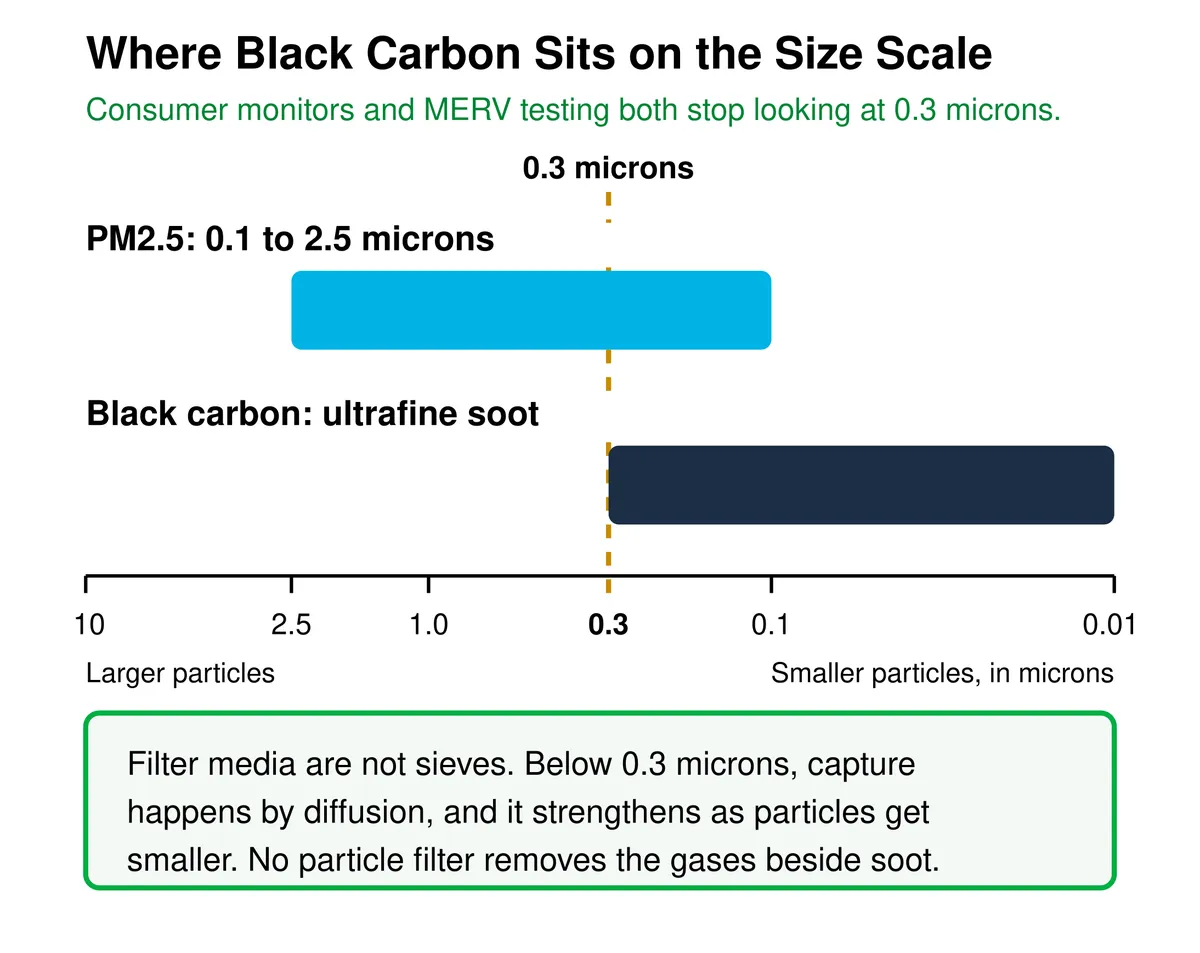
MERV 13 media capture microscopic particles, and ASHRAE Standard 52.2 scores that rating no lower than 0.3 microns. Most black carbon by particle count sits below that line, where capture works by diffusion and strengthens as particles shrink.
Answer three quick questions and we will match you to the right filter for your system.
Know your size already? Shop pleated filters made in the USA at Filterbuy in over 600 sizes, factory direct.
Black carbon is the sooty core of combustion smoke, the slice of PM2.5 from diesel engines, wood stoves, and wildfires. Per microgram inhaled, studies associate it with larger health effects than PM2.5 as a whole, and it warms the climate more than any human emission except carbon dioxide. It also slips indoors more easily than homeowners expect.
Black carbon is a component of PM2.5, not a separate pollutant: the carbon core of soot.
Mobile sources produce roughly 52% of U.S. black carbon emissions; diesel was about 93% of that in 2005.
Janssen et al. (2011) found health effects per 1 µg/m³ were greater for black carbon than for PM2.5 or PM10.
Houses are leaky: indoor/outdoor ratios in a wood-burning community averaged 0.78.
No AQI app reports black carbon, and most consumer monitors cannot see it either: their sensors stop at 0.3 microns.
Black carbon is the light-absorbing carbon particle formed when diesel, wood, coal, or biomass burns incompletely. The EPA's black carbon assessment identifies it as the most strongly light-absorbing component of particulate matter. Scientists say black carbon; everyone else says soot.
The two are not quite interchangeable. Soot is a mixture of black carbon, organic carbon, and metals; black carbon is its dark elemental fraction, the part researchers use as a combustion fingerprint. Freshly emitted, the particles measure tens to a few hundred nanometers, small enough to reach deep lung tissue.
In the United States, black carbon comes overwhelmingly from engines. EPA attributes about 52% of domestic emissions to mobile sources, diesel being roughly 93% of that in 2005, with open biomass burning supplying most of the rest.
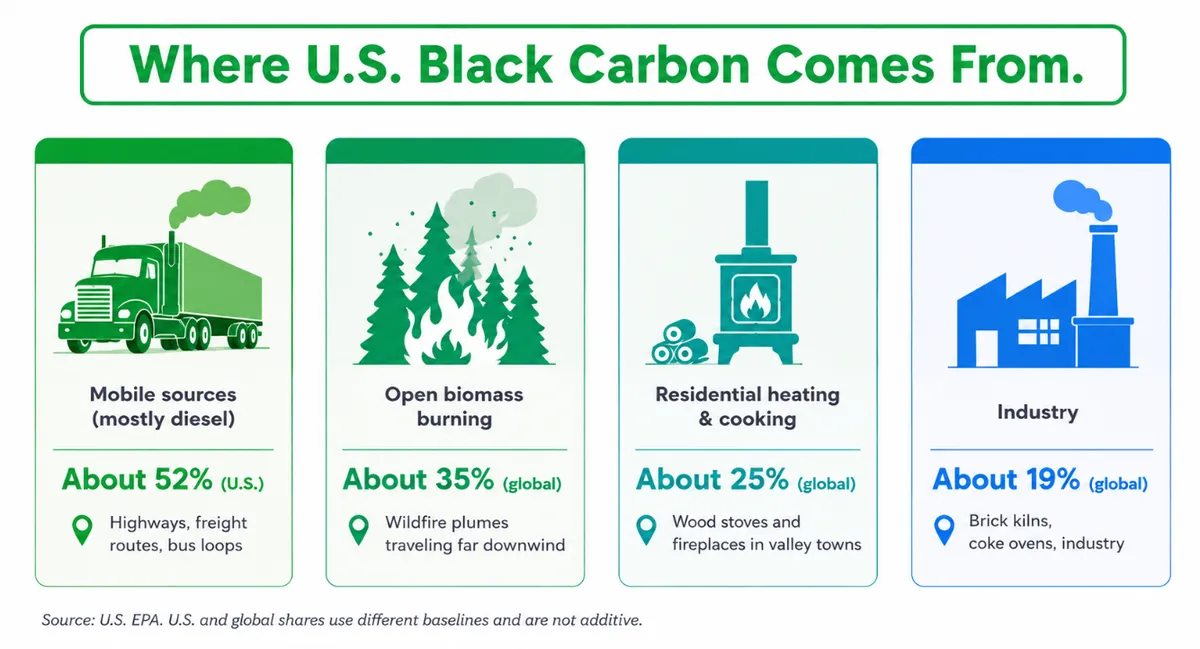
Exposure therefore takes a shape. Near a highway it is chronic and year-round; where neighbors burn wood it is seasonal, spiking on cold nights. Elsewhere it arrives in episodes, alongside how wildfire smoke drives your local AQI.
Black carbon is part of PM2.5, not an alternative. PM2.5 is a size category covering every airborne particle 2.5 microns or smaller whatever they are made of. Black carbon is a compositional category: elemental carbon from something burning.
That last row is why this page exists. Black carbon hides inside the PM2.5 number, so two days with the same AQI can carry different risk.
Black carbon exposure is associated with cardiovascular and respiratory harm, more strongly per microgram than PM2.5 as undifferentiated mass. In a 2011 systematic review in Environmental Health Perspectives, Nicole Janssen and colleagues at the Dutch National Institute for Public Health found effects per 1 µg/m³ were greater for black carbon than for PM10 or PM2.5. Reviewing the evidence for the WHO Regional Office for Europe, the same team linked daily outdoor black carbon to all-cause and cardiovascular mortality, and calculated a life-expectancy gain four to nine times higher per unit of black carbon than of PM2.5.
That compares equal masses that never occur in equal masses; scaled by interquartile range, the same paper notes, the estimates converge. Black carbon is the better tracer, not nine times deadlier.
In 2012 the International Agency for Research on Cancer classified diesel engine exhaust as carcinogenic to humans (Group 1) on lung cancer evidence. In 2019 a Belgian team led by Hannelore Bové reported in Nature Communications that black carbon turned up in every human placenta they screened, the load rising with the mother's exposure. A later comment disputed which side they occupied. What nobody disputes: inhaled soot does not stop at the lungs.
Yes. Black carbon warms the planet by absorbing sunlight and dulling the snow it lands on. In the 2013 assessment led by Tami Bond, 31 authors put its industrial-era forcing at +1.1 W/m², second only to carbon dioxide. The difference is timing: CO₂ lingers for centuries while black carbon washes out in weeks, so cutting it pays a climate and health return at once.
Most of it gets in. In a California town where wood burning was the only particle source, researchers measured an average indoor/outdoor black carbon ratio of 0.78 in homes with no combustion of their own, and a penetration factor of 0.97. Their conclusion was blunt: a house gives little protection from fresh wood smoke.
Two lessons follow. Closing the windows helps less than homeowners assume, since ultrafine soot rides through the gaps every envelope has. And the traffic outside is not always the culprit: your own fireplace, gas range, or garage can lift indoor levels past outdoor ones.
A well-fitted MERV 13 filter is the practical answer to black carbon at home, and it works better against ultrafine soot than its rating implies. One thing first: we make the filter. Filterbuy has built pleated filters in the USA for over a decade, and the MERV number on the frame is one we print.
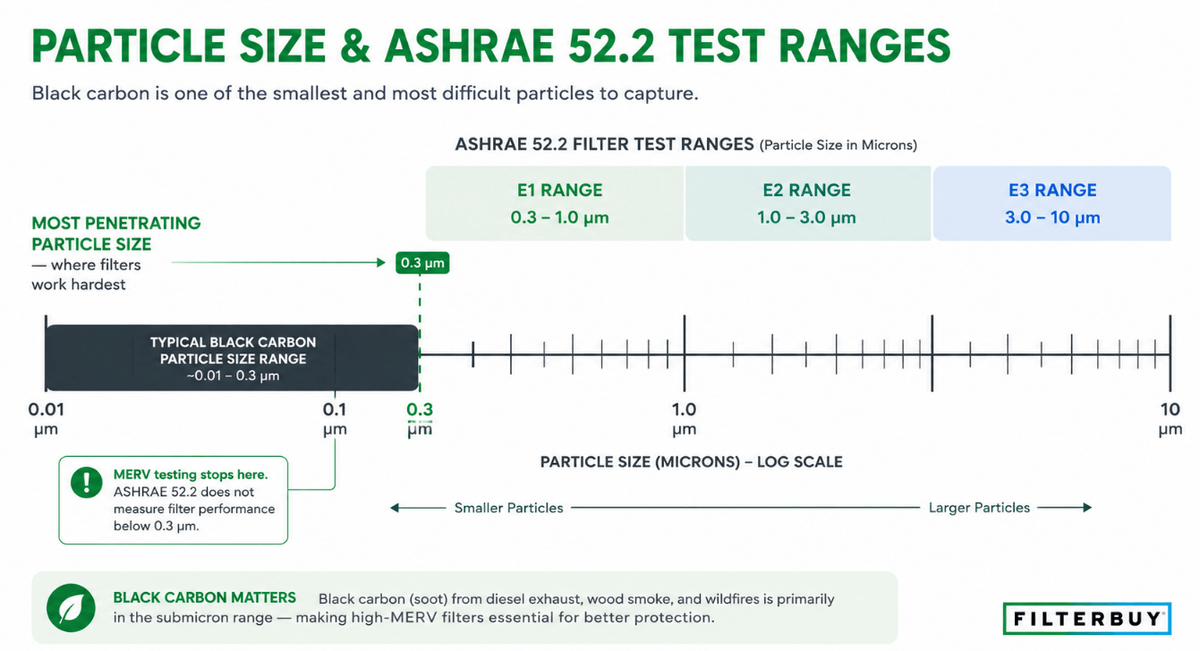
MERV ratings come from ASHRAE Standard 52.2, which tests three size groups: E1 (0.3–1.0 microns), E2 (1.0–3.0), E3 (3.0–10.0). MERV 13 must capture at least 50% of E1. Notice where the test stops: most black carbon by particle count sits below 0.3 microns, territory the standard never scores.
Every page treats that gap as a weakness. We read it the other way, because filters are not sieves. Media capture particles by impaction and interception, which strengthen as particles grow, and by diffusion, which strengthens as they shrink. Between them sits a valley near 0.3 microns, the most penetrating size. Below it efficiency climbs, the physics governing ultrafine particles smaller than PM2.5. MERV 13's rated E1 number is therefore closer to a worst case for black carbon than a best case. The real limitation sits elsewhere: no particle filter removes the gases traveling alongside soot.
Consumer air quality monitors share that blind spot. Most PM2.5 devices are optical particle counters whose detection floor also sits at 0.3 microns, so one bought to check for soot reports only the share big enough to see.
“Every filter we make carries a MERV number measured down to 0.3 microns and no further. Most black carbon is smaller than that. We could stay quiet and let people assume the rating covers everything. I would rather explain why the physics runs in your favor below that line.”
— Michelle Wan, Brand Manager and Air Quality Writer, Filterbuy
Three federal findings, gathered because we could not find them together anywhere else.
45 million Americans live within 300 feet of a major road, rail line, or airport. EPA uses it to frame its near-source research program, noting these pollutants cause heart and lung disease. Source: EPA Air Research, near-roadway air pollution.
Wood heat is the primary fuel in 2% of U.S. homes but drives 22% of winter fine-particle exposure. A January 2026 study attributed 2.43 µg/m³ of winter PM2.5 to wood combustion and roughly 8,600 deaths a year. Source: Shlipak et al., Science Advances, via NIH PubMed Central.
MERV 13 held one home's indoor/outdoor PM2.5 ratio to 0.55 during a wildfire; a clean room took it to 0.22. Outdoor PM2.5 averaged 260 µg/m³ in that smoke event; indoor held at 134 with MERV 13 alone, 30 with a cleaner too. Source: Antonopoulos, Dillon and Gall, Pollutants, via NIH PubMed Central.
Beside the 0.78 measured with no intervention, those numbers form a ladder:
0.78 with no intervention at all
0.55 with MERV 13 running in a central system
0.22 with MERV 13 plus a portable cleaner in one room
Three studies, one ladder Filterbuy assembled because nobody had put the rungs together. You cannot move the first number; you control the other two.
“When someone near a truck route calls us, the rating on the frame is rarely the problem. It is a filter nobody changed in six months, or one seated loose enough that air travels around it. A MERV 13 you never replace performs like a MERV 8.”
— David Clark, Licensed HVAC Technician and President of Filterbuy HVAC Solutions
Three moves: filter the air, cut your own sources, add a clean room if someone is vulnerable. Fit MERV 13, set the fan to "On" during smoke events, replace it on schedule; if unsure which rating your system tolerates, compare MERV 8, 11 and 13 for high-AQI days. Then skip the fireplace on stagnant nights, run the range hood, never idle in the garage, weatherstrip doors and ducts. If anyone at home has asthma, heart disease, or is pregnant, add a bedroom cleaner, because MERV 13 and HEPA do different jobs.
No. Black carbon is one component of PM2.5. PM2.5 is defined by size, black carbon by what the particle is made of. All black carbon counts as PM2.5; most PM2.5 is not black carbon.
Yes, although no MERV rating certifies performance below 0.3 microns, where much of it sits. Because diffusion makes capture more efficient below that size, MERV 13 generally handles ultrafine soot at or above its rated E1 efficiency. It cannot remove accompanying gases.
Neither is safe; the useful question is which reaches you. Diesel exhaust carries a formal IARC Group 1 carcinogen classification. Wood smoke dominates winter nights in many U.S. towns and drives higher short-term indoor levels near a burning neighbor.
Black carbon is not spread evenly, and no app reports your number. Two or more of these and it is worth acting on:
You or your kids' school sit within 300 feet of a highway, truck route, or rail yard.
Someone on your street burns wood on cold winter nights.
You have an attached garage holding a diesel vehicle or gas equipment.
Your used filter comes out dark and sooty rather than pale grey.
Black carbon is the part of air pollution that comes from something burning, and the part most worth reducing. No AQI app reports it, so check the live AQI map for your area and read the PM2.5 number knowing what hides inside. You cannot control the freight route or your neighbor's stove. You can control what your HVAC pulls from the air.
Filterbuy manufactures pleated MERV 13 filters in over 600 sizes, factory-direct. Find your size and set up auto-delivery so a fresh one arrives on time.
Black carbon (BC): The light-absorbing elemental-carbon particle from incomplete combustion, emitted directly as part of PM2.5.
MERV: Minimum Efficiency Reporting Value, the ASHRAE 52.2 scale of 1 to 16. MERV 13 captures at least 50% of particles from 0.3 to 1.0 microns.
Most penetrating particle size (MPPS): The diameter a filter captures least efficiently, near 0.3 microns. Efficiency rises above and below it.
