Shop by
August 17, 2026
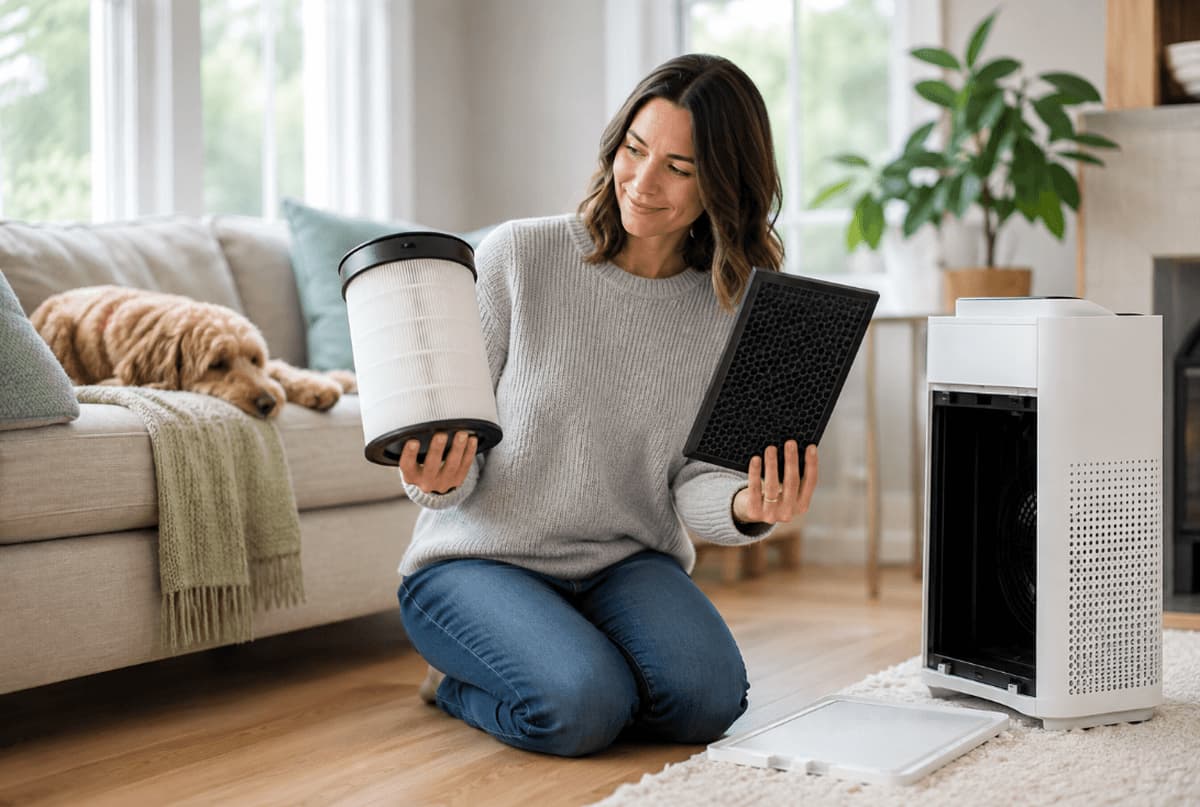
HEPA filters and activated carbon filters solve two entirely different problems, and they wear out on two different schedules. HEPA captures solid particles (dust, pollen, pet dander) through mechanical filtration and typically lasts 6–12 months.
Activated carbon adsorbs gases, odors, and volatile organic compounds (VOCs) through a chemical process and usually needs replacing every 3–6 months. Neither filter can do what the other does, which is why most quality air purifiers include both. According to the U.S. Environmental Protection Agency (EPA), these two filtration methods target distinct pollutant categories and work best when used together.
You've probably glanced at your air purifier and noticed two filters stacked together without giving much thought to why.
They're not redundant. They're not interchangeable. Each one is targeting a completely separate category of air pollutant, and understanding the difference will change how you maintain your purifier and whether it's actually doing its job.
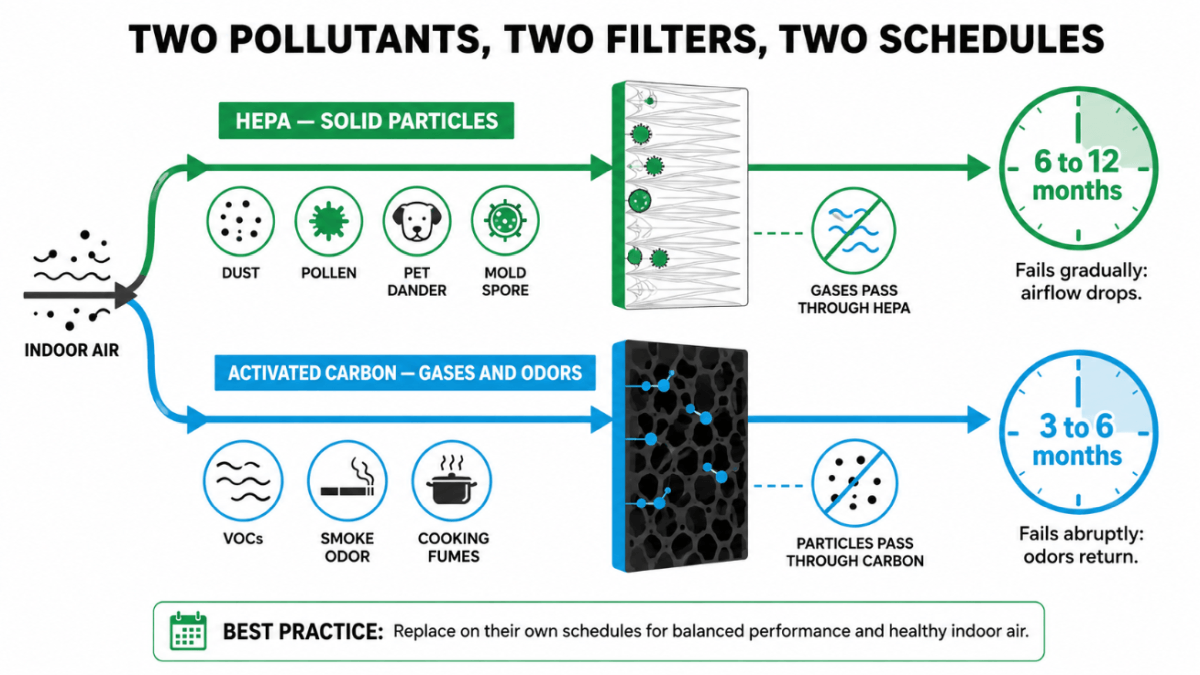
HEPA and activated carbon filters remove two completely different types of pollutants — HEPA traps solid particles, carbon adsorbs gases and odors — and neither one can do the other's job.
HEPA filters capture 99.97% of particles 0.3 microns or larger, including dust, pollen, pet dander, and mold spores.
Activated carbon filters target VOCs, smoke odor, cooking fumes, and chemical gases that pass straight through a HEPA filter untouched.
The two filters fail differently and need separate replacement schedules: HEPA typically lasts 6–12 months and degrades gradually, while carbon typically lasts 3–6 months and fails abruptly once it's saturated.
Syncing both filters to the same replacement date wastes one filter's remaining life or leaves the other running past its limit.
HEPA stands for High-Efficiency Particulate Air. A True HEPA filter captures 99.97% of airborne particles 0.3 microns or larger, including dust, pollen, mold spores, pet dander, and most bacteria, according to the U.S. Department of Energy's HEPA filter standard.
The filter itself is a dense mat of randomly arranged fibers. As air passes through, particles get trapped through three distinct mechanisms:
Interception: Larger particles following an airstream brush against a fiber and stick.
Impaction: Mid-sized particles can't follow the curving airstream around a fiber and collide directly with it.
Diffusion: The smallest particles (under 0.1 microns) move erratically due to Brownian motion, which actually makes them more likely to contact a fiber, not less.
What HEPA cannot do is equally important to understand. Gases, smoke odor, formaldehyde, benzene, and other VOCs pass straight through a HEPA filter.
These are molecular-level pollutants, far too small to be caught by mechanical filtration. If you notice your purifier running but still smell cooking fumes or paint, that's not a defective HEPA filter. It's just a HEPA filter doing exactly what it was designed to do.
This is where a common misconception needs clearing up: activated carbon filters adsorb pollutants; they do not absorb them. The difference matters.
Absorption means a substance is soaked up and incorporated into another material (like a sponge taking in water). Adsorption is a surface-level chemical process: gas molecules are attracted to and bond with the surface of the carbon material, where they stay trapped.
Activated carbon is processed to be extraordinarily porous. A single gram of activated carbon can have a surface area exceeding 1,000 square meters. That massive surface area creates an enormous number of bonding sites for gas molecules to latch onto.
What does activated carbon target? Primarily:
VOCs (volatile organic compounds) from cleaning products, paints, and building materials
Cooking odors
Tobacco and wildfire smoke odors
Formaldehyde and benzene
Pet odors
What it cannot do: activated carbon doesn't trap particles. Dust, dander, and pollen float right through. Carbon filters address the chemical composition of your air; HEPA filters address the physical particles in it.
Particles and gases are separate categories of air pollution. One filter type handles one category. That's the core reason dual-filter air purifiers exist, not as a marketing upsell, but because clean indoor air requires addressing both problems simultaneously.
Consider wildfire smoke. It contains both fine particulate matter (PM2.5) and a complex mixture of gases and VOCs. A HEPA-only purifier running during wildfire season will capture the particles but let the chemical compounds pass through, which is why rooms can still smell like smoke even when the air looks clear. Add a carbon layer, and both pollutant categories get addressed.
The same logic applies to everyday scenarios:
Cooking: Grease particles + odor compounds. HEPA catches the particles; carbon handles the smell.
Pets: Dander (particles) + pet odors (gases). Two separate filtration problems.
Allergy season: Pollen is a particle job, so HEPA dominates here, but if someone in the household is also sensitive to cleaning products or fresheners, carbon matters too.
Neither filter compensates for the absence of the other. They're complementary by design.
Yes, and this surprises most people. The two filters degrade differently, which means they run on different replacement timelines.
HEPA filters typically last 6–12 months under normal use. As they accumulate particles, airflow gradually decreases, and the filter gets physically denser and harder for air to pass through.
This degradation is slow and measurable: you'll notice reduced airflow from the unit, more dust visibly settling on surfaces, or an indicator light (if your purifier has one).
Carbon filters usually need replacement every 3–6 months. Unlike HEPA, carbon doesn't clog in a way you can measure by airflow. Instead, once the surface bonding sites are fully occupied (once the carbon is saturated), it simply stops adsorbing.
Odors pass through as if the filter weren't there. The failure is abrupt rather than gradual, with no airflow change to signal the problem. The EPA notes that activated carbon filters have a finite adsorption capacity and should be replaced regularly to maintain effectiveness.
Several factors accelerate both filters' depletion:
Pets (increased dander load on HEPA; pet odors drain carbon faster)
Smokers or frequent candle use (carbon saturation accelerates significantly)
Heavy daily cooking
Wildfire season (both filters can deplete in weeks under heavy smoke conditions)
High-occupancy rooms (more people = more particulates and more VOCs from breath, products, and activity)
For HEPA, look for these signals:
Noticeably reduced airflow from the purifier's output
More dust settling on furniture despite the unit running
A filter replacement indicator light (on purifiers equipped with one)
Visually inspecting a HEPA filter can be misleading, as a heavily loaded filter often still looks intact. Airflow is the more reliable gauge.
For carbon, the smell test is the most reliable method: introduce a moderate odor near the intake (cooking smells work well), run the purifier, and assess the output air.
If familiar odors are no longer being neutralized, the carbon is saturated. Some purifiers include separate indicators for carbon, but many don't, and in those cases, the odor test is your best diagnostic.
The key takeaway from everything above: because HEPA and carbon filters do different jobs, they wear out in different ways, and that means they need separate replacement schedules.
Don't treat them as a single maintenance event. Carbon saturates chemically and should be swapped out at the 3–4 month mark, especially if you cook frequently, have pets, or live in a region prone to wildfire smoke.
HEPA clogs physically and can run its full 6–12 month cycle, unless airflow drops noticeably sooner. Syncing both filters to the same calendar date will either waste a filter's remaining life or leave the other one overdue.
When sourcing replacements, use filters matched to your specific purifier model. Generic or mismatched filters can fail to form a proper seal, creating bypass channels where unfiltered air skips the media entirely and defeats the purpose of having the filter at all.
Filterbuy offers a broad selection of air purifier replacement filters and replacement reminder options to help you stay on schedule without having to track it manually.
Yes, but your purifier will only address particulate pollution: dust, pollen, pet dander, and similar particles. Gases, VOCs, cooking odors, and smoke odors will pass through unchecked. For most households, a HEPA-only setup leaves a meaningful gap in air quality coverage.
Yes. Activated carbon is reactive and will slowly adsorb compounds from ambient air even when not in active use inside a purifier. A sealed, unopened replacement filter stored in a cool, dry location retains its effectiveness longer, but an opened filter left sitting out will begin to deplete.
Avoid unpacking replacement filters until you're ready to install them.
No. Once the bonding sites on activated carbon are occupied, the adsorption process is essentially permanent under normal conditions. Vacuuming a carbon filter may remove surface dust but does nothing to restore its chemical capacity. Carbon filters are consumables: replace, don't refresh.
0.3 microns is the particle size a HEPA filter finds hardest to capture, not the smallest. Particles both larger and smaller are actually easier to trap (via impaction/interception and diffusion, respectively). HEPA certification requires 99.97% capture efficiency at exactly this most-penetrating particle size, making it the industry standard benchmark.
Check the product manual or the filter compartment directly. Most multi-stage purifiers label each layer. A carbon filter typically looks like a thin, dark gray or black mesh or sheet; a HEPA filter is usually a pleated white or off-white material. Some purifiers combine both into a single unit, so check the product specifications to confirm whether true activated carbon (not just a carbon coating) is included.
