Shop by
August 20, 2026
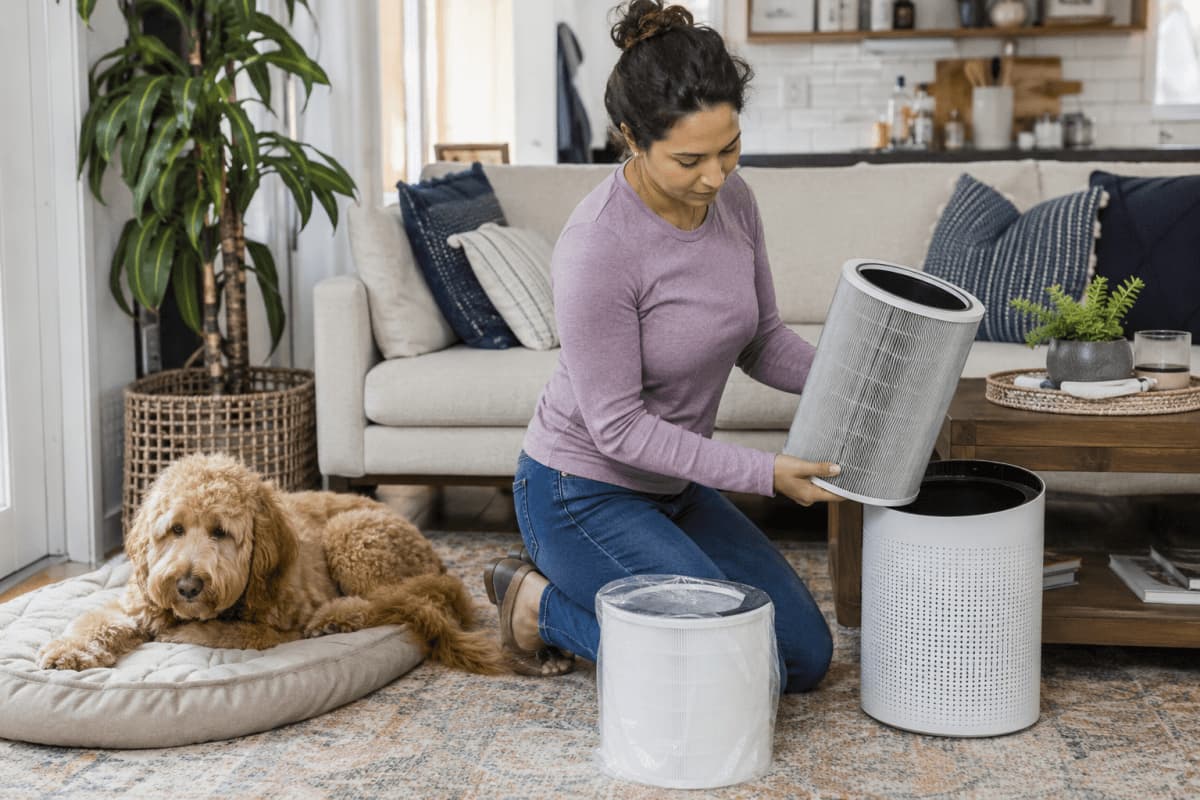
Match your purifier’s exact model number, then confirm the listing says “True HEPA” with a stated efficiency percentage. Room air purifiers are not standardized the way HVAC filter sizes are, so the brand name alone will not get you the right cartridge.
Open the filter compartment and check whether your unit takes one combined 3-in-1 cartridge or separate pre-filter, HEPA, and carbon layers. Each layer runs on its own replacement clock.
What the listing should say:
“True HEPA, 99.97% at 0.3 microns” — meets the U.S. Department of Energy standard.
“H13 HEPA, 99.95% at MPPS” — meets the European EN 1822 standard.
“HEPA-type” or “medical grade” with no number — no enforced standard behind the claim.
Filterbuy manufactures pleated air filters in our own U.S. plants and ships factory-direct. Not sure what your home needs? The quiz below takes about a minute.
Answer a few quick questions and we’ll match you to your filter.
Or shop air filters at Filterbuy.com — made in our own U.S. plants, shipped factory-direct.
A HEPA air purifier replacement filter is the consumable cartridge inside a portable room air purifier, and most need replacing every 6 to 12 months. Getting the right one comes down to matching your unit’s exact model number, then confirming the listing says "True HEPA" with a specific efficiency percentage. Check whether your model takes one combined 3-in-1 cartridge or separate layers. Filterbuy, an American filter manufacturer since 2013, makes pleated HVAC filters rather than purifier cartridges, so we have no filter of ours to sell you here.
HEPA is defined by the U.S. Department of Energy as capturing at least 99.97% of airborne particles at 0.3 microns.
0.3 microns is the hardest particle size to catch, not the smallest a HEPA filter catches. The EPA states that particles both larger and smaller are trapped at even higher efficiency.
"HEPA-type" and "HEPA-like" have no enforced standard behind them. "True HEPA" with a stated percentage is the phrase to look for.
Your model number is the only reliable way to order the right filter. Room purifiers are not standardized the way HVAC filter sizes are.
A HEPA air purifier replacement filter is the removable cartridge inside a portable room air purifier, and it does the actual work of catching whatever floats through the room. It looks nothing like the flat HVAC filter in your furnace return. Purifier cartridges tend to be cylindrical, built for one specific unit, and swapped out on a schedule rather than serviced.
The acronym stands for high-efficiency particulate air. The U.S. Environmental Protection Agency describes it as a pleated mechanical filter defined by the U.S. Department of Energy, one capable of removing at least 99.97% of dust, pollen, mold, and bacteria at 0.3 microns.
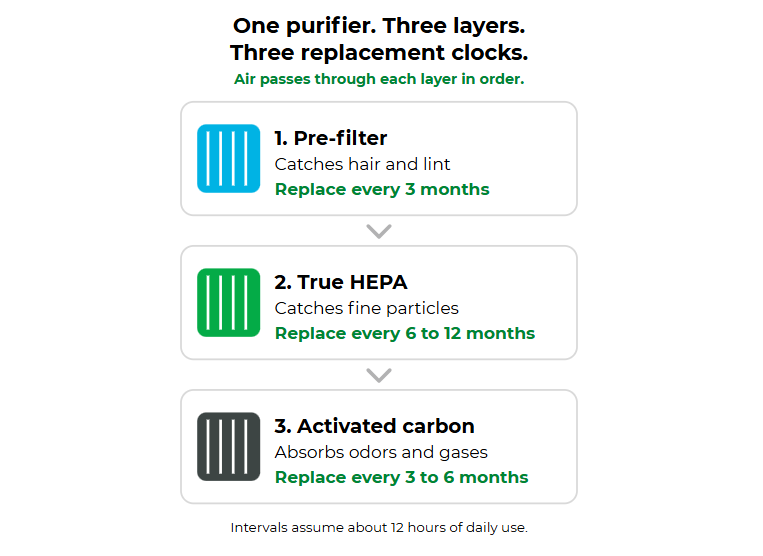
Inside most purifiers those fibers sit in the middle of a stack. A pre-filter catches hair and lint on the way in, the HEPA layer handles fine particles, and an activated carbon layer absorbs odors and gases. Some manufacturers combine all three into a single 3-in-1 cartridge you replace as one piece. Others keep them separate, each running on its own clock, which changes what you end up buying.
Most listings for air purifier filters repeat the same line: "captures particles down to 0.3 microns." Read plainly, it suggests anything smaller sails straight through. That’s the most common misreading of how HEPA media works. The number is real and the standard behind it is real. What the phrasing gets wrong is the direction, and that changes which air purifier replacement filters are worth your money.
The truth runs the other way. The EPA is explicit that 0.3 microns is the most penetrating particle size, meaning the single hardest diameter for a filter to catch. Particles larger and smaller than that are trapped at even higher efficiency.
The physics is simple enough. Very small particles move erratically instead of travelling in straight lines, so they collide with filter fibers rather than slipping past. A True HEPA cartridge isn’t blind to ultrafine smoke particles. If anything it handles them better than the benchmark it’s rated on.
None of this makes a listing that says down to 0.3 microns a red flag. The phrase is boilerplate. Pay attention instead to what a listing leaves out. One that avoids the word "True," quotes no efficiency percentage, and falls back on "medical grade" is telling you something. "HEPA-type" and "HEPA-like" don’t have an enforced standard behind them, and real performance varies widely.
MPPS is the most penetrating particle size. Standards: U.S. Department of Energy (HEPA) and EN 1822 (H13).
Once you know what to look for, finding the right filter takes about two minutes. Start from the model number rather than a tape measure, because room purifiers aren’t standardized the way HVAC filter sizes are. Two units from the same brand often take completely different cartridges:
Find your unit’s model number. It’s on a label on the back or underside of the unit, and on the original box. The brand alone won’t do it.
Open the compartment and count the layers. One combined cartridge, or separate pre-filter, HEPA, and carbon? This changes what you order.
Check the filter part number. Most makers print it on the filter frame or compartment door.
Confirm the efficiency language. Look for "True HEPA" plus a stated percentage and particle size.
Order a spare with it. A spare on the shelf is the most reliable way to actually swap it on schedule.
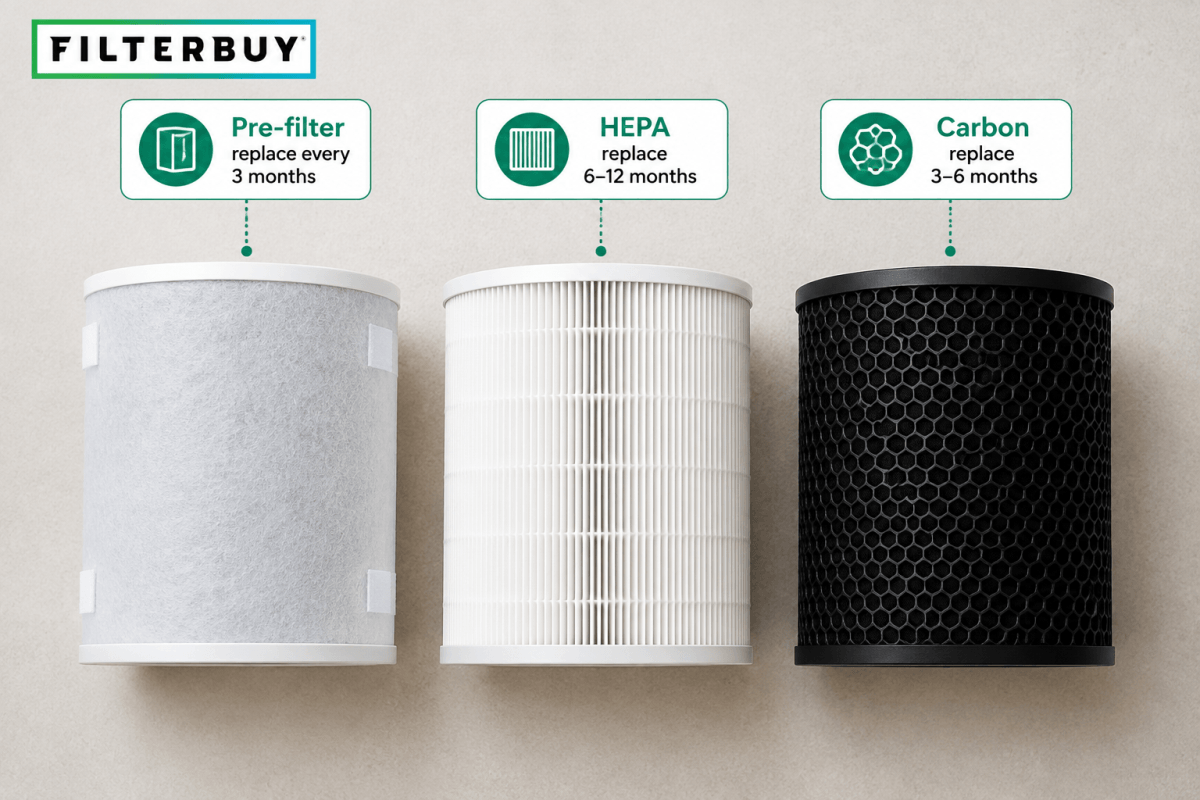
Most HEPA air purifier replacement filters need changing every 6 to 12 months, though the layers around them wear out considerably faster. Pre-filters run on roughly a three-month cycle and carbon on three to six. That mismatch is why a purifier can start underperforming while the HEPA cartridge itself still looks perfectly usable.
Intervals assume roughly 12 hours of daily use. If two or more accelerating factors apply to your home, plan for the shorter end of each range.
Don’t wash a HEPA filter to stretch it. Water damages the fine fiber matrix that makes the media work, and vacuuming tends to open gaps in it. You can rinse a washable pre-filter if your unit has one, but the HEPA behind it keeps running on its own clock. Here’s a quicker test than any calendar: hold the filter up to a light. If light doesn’t pass through the pleats, replace it.
For the full breakdown, including the six signs a filter is overdue before the indicator light fires, see our guide to how often to replace air purifier filters.
The price of a single filter tells you almost nothing when you buy air purifier filters. What decides the purchase is what the full stack costs across twelve months, and you won’t find that figure on any purifier listing. Work it out before you buy the unit rather than after:
Price every layer your model takes. Pre-filter, HEPA, and carbon separately, or one combined cartridge.
Multiply each by its replacements per year. Pre-filter about 4. Carbon 2 to 4. HEPA 1 to 2. A 3-in-1 cartridge, 1 to 2.
Add them together. That total is your real annual cost.
Run that math across a few models and the ranking often flips. A cheap purifier taking a short-life 3-in-1 cartridge twice a year can cost more to own than a pricier one with separate layers and a 12-month HEPA. We see the same thing on the HVAC side, where the filters outrun the equipment cost over time.
A spent HEPA filter is holding months of captured dust and particles. Handle it like it’s full, because it is.
Power the unit down and wait for the fan to stop completely.
Slide the old filter out slowly. Don’t shake it, tap it, or blow it out.
Bag and seal it before it leaves the room.
Wipe the empty housing with a damp cloth rather than a dry duster.
Most spent home filters can go straight into the household trash. Check your local rules and your purifier maker first, since some run take-back programs.
The best air purifier filters are the ones that state a real efficiency spec and seat properly in a unit whose performance was independently tested. No single brand wins this outright. Before you commit to years of replacement cartridges, check whether the unit they feed was ever tested at all. Four marks turn up on purifier packaging, and each one verifies something narrower than most shoppers assume.
Sources: EPA Guide to Air Cleaners in the Home; California Air Resources Board list of certified air cleaning devices.
Any model can be searched in the AHAM directory of verified room air cleaners and the CARB list of certified air cleaning devices. The EPA’s Guide to Air Cleaners in the Home publishes a table matching CADR, or how fast a unit clears a room, to room size. Skip any unit that intentionally produces ozone, which is a lung irritant.
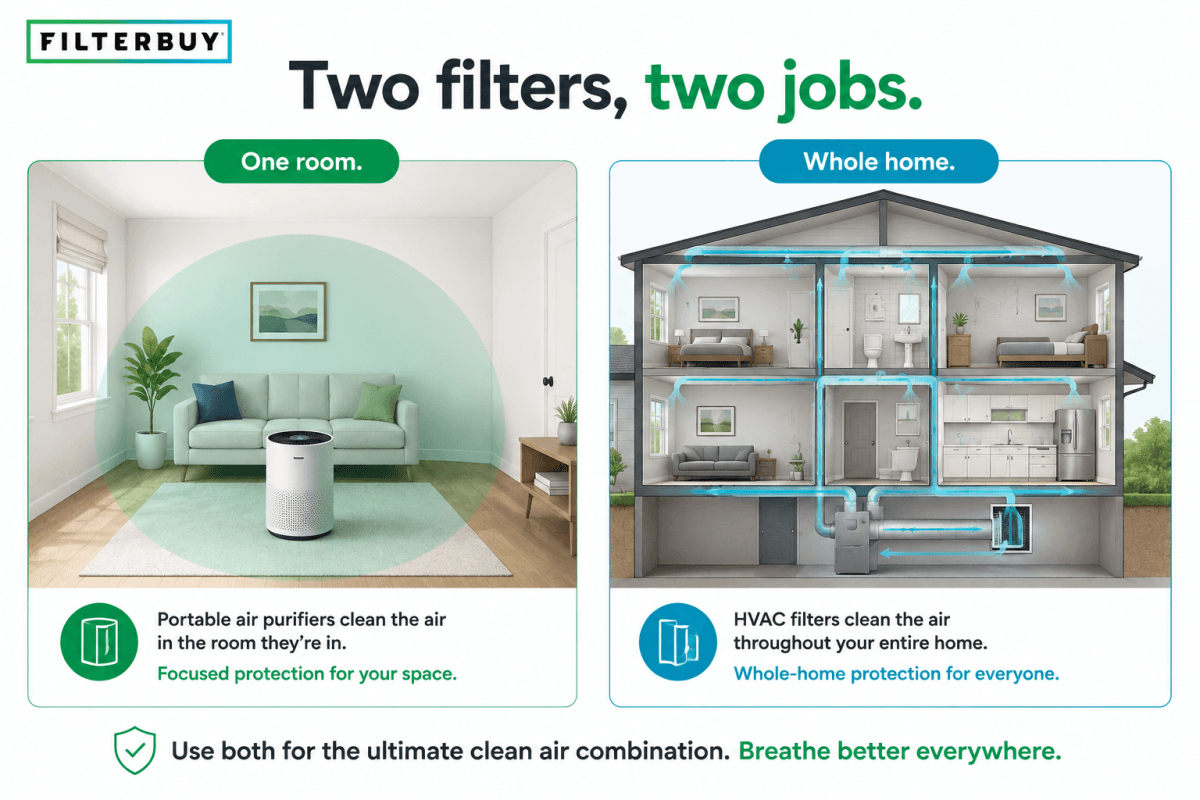
Filterbuy is a manufacturer, not a reseller. We cut, pleat, and frame pleated HVAC filters to order in our own US plants, and we don’t make or sell purifier cartridges, so nothing above was written to move a product of ours. Here’s the part we can help with. A purifier cleans one room and never touches the air moving through your ductwork into every other room. Pair a good purifier with a loaded furnace filter and most of your home’s air untreated.
On the HVAC side, pick the tier that matches what you’re dealing with. MERV, the scale that rates how much an HVAC filter captures, runs in steps you can choose from directly.
MERV 8 captures 90% of airborne particles. The standard choice for most homes.
MERV 11 captures 95% of airborne particles. For allergies and asthma, and for pets and pollen.
MERV 13 captures 98% of airborne particles. The tier for smoke.
Odor Eliminator carbon filters. For odors.
Whichever tier you pick, check your HVAC manual for compatibility. It’s the same quick check you’d do on size, and it takes a minute.
Finding your size is the easy part. Measure the old filter first, or the slot if there isn’t one, then order that nominal size. If yours isn’t listed, we cut custom sizes to the eighth of an inch. Shop MERV 13 air filters or Odor Eliminator carbon filters.
Delivery is fast and free 2-day to most US states. Auto-delivery means the next filter arrives before the current one is spent. Not sure which you need? Find your filter match takes about a minute, or read how HVAC filters and portable purifiers differ.
Three findings from US government and public health sources sit behind the advice above:
A HEPA filter set cut indoor PM2.5 by 78.8%.
Rutgers ran a randomized crossover trial in 27 New Jersey homes.
Same air cleaner throughout. Filter installed 24 hours, removed 24 hours.
PM2.5 fell 78.8% in the room with the unit, 57.9% in a second room.
Source: Lu et al., via CDC Stacks, 2024
Closed windows alone leave you at 55% to 60%.
Indoor PM2.5 as a share of outdoor levels during wildfire smoke.
No air cleaner running. Homes range from 30% to 100%.
The same EPA guidance says to check the filter often and replace it when dirty.
Source: U.S. EPA, Strategies to Reduce Exposure Indoors
152.3 million Americans live where the air fails.
That is 44% of the U.S. population.
These counties failed on ozone or particle pollution.
Among them: 11.9 million adults and 2.4 million children with asthma.
Source: American Lung Association, State of the Air 2026
Source links appear in the body copy above. The Custom HTML sanitizer strips anchor tags, so links cannot be placed inside this table.
Not yet. We make pleated HVAC, furnace, AC, and mini-split filters. For a portable purifier, order the cartridge built for your model number from the purifier maker or a compatible-filter supplier.
Yes, as long as it’s built for your specific model and states a real efficiency spec. Fit is the thing to check. A filter that doesn’t seal lets air slip around the media, and then it doesn’t matter how good that media is.
Check the filter frame and the product listing for "99.97% at 0.3 microns" (U.S. DOE standard) or "99.95% at MPPS" for H13 filters under EN 1822. A percentage paired with a particle size is a real spec. "HEPA-type" with no number isn’t.
Yes. A purifier treats the room it sits in. Your HVAC filter treats the air circulating through the whole house and keeps the equipment cleaner too.
Still not sure which cartridge your unit takes? Take the model number to its maker first. If the question turns out to be about the filter in your furnace or return, we’ll help. Call us at (855) 345-8289.
HEPA: High-efficiency particulate air. A mechanical filter type defined by the U.S. Department of Energy as capturing at least 99.97% of particles at 0.3 microns.
True HEPA: Labeling indicating a filter meets the full DOE HEPA standard, as opposed to unregulated "HEPA-type" claims.
MERV: Minimum Efficiency Reporting Value. The scale rating HVAC filters on capture of particles from 0.3 to 10 microns. MERV 13 is not HEPA.
PM2.5: Fine particulate matter 2.5 microns across or smaller. It’s the size found in smoke and haze.
Pre-filter: The first layer in a purifier, catching hair and lint so the HEPA layer lasts longer.
MPPS: Most penetrating particle size. The diameter a filter captures least efficiently, roughly 0.3 microns for HEPA media; particles above and below are captured more efficiently.
Filterbuy: A family-owned US air filter manufacturer founded in 2013. We cut, pleat, and frame filters to order in our own plants and sell factory-direct.
