Shop by
Pros, Cons & Best Applications (2026)
A ceiling cassette mini split hides its indoor unit above the ceiling and pushes air out in four directions through a flush grille, while a wall-mounted mini split mounts on the wall and blows air in one direction. The cassette costs more to install and needs roughly 22.5 inches of ceiling cavity, but it evens out airflow across large or open-concept rooms. A wall-mounted unit costs less and works well in bedrooms and smaller spaces.
Answer three quick questions below and we will match you to the right mini split system for your space.

Answer 3 quick questions and we'll match you to your perfect mini split.
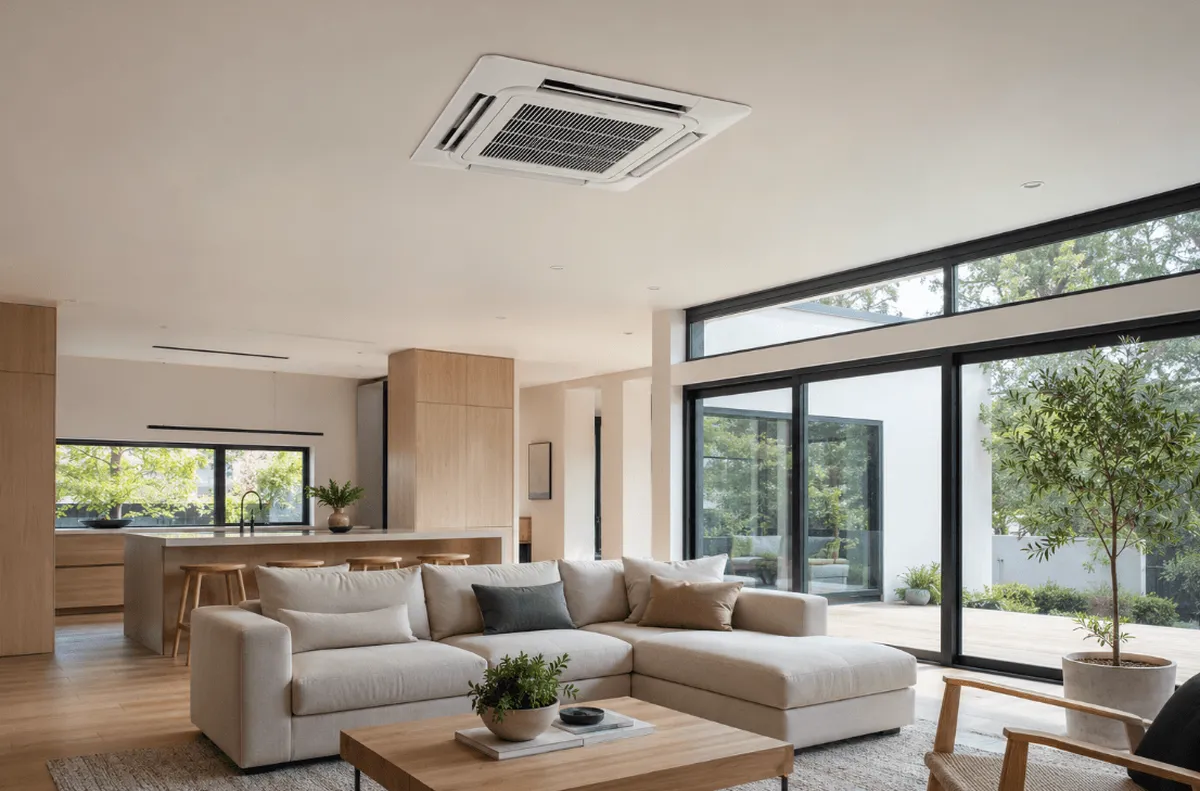
A ceiling cassette mini split hides its indoor unit inside the ceiling and pushes air out through a slim, flush grille in four directions, so no unit shows on the wall. It costs more to install and needs a nearby access panel, but it earns that cost back in large or open-concept rooms where even airflow matters more than the lowest price.
A ceiling cassette sits flush inside the ceiling and releases air through a slim grille, so no indoor unit is visible.
Installation costs more than a wall-mounted unit because a cassette needs roughly 22.5 inches of cavity depth, often a condensate pump, and a dedicated access panel.
Four-way airflow spreads conditioned air evenly across large or open-concept rooms in a way one wall-mounted unit cannot match.
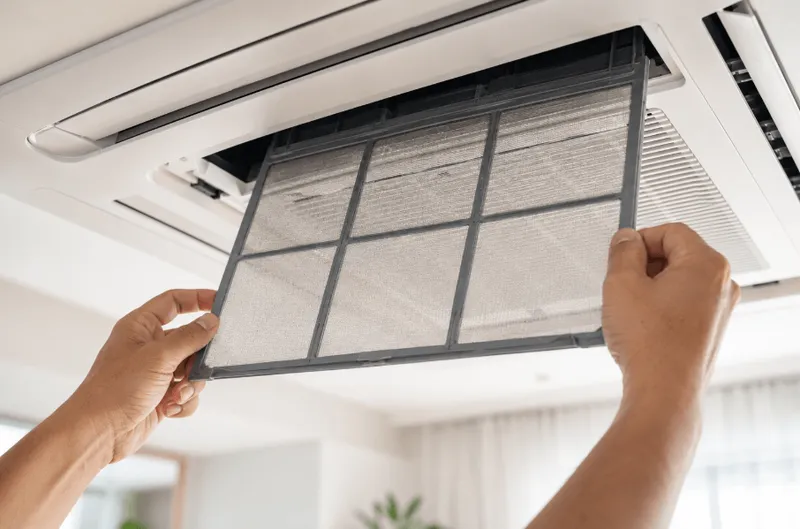
The washable filter sits behind a drop-down grille and should be cleaned roughly every two weeks during heavy use.
Cassettes earn their higher price in great rooms and open floor plans, while wall-mounted units stay cheaper for smaller rooms.
A ceiling cassette mini split is a ductless heating and cooling unit that installs above the ceiling instead of on a wall, also called a recessed mini split or four-way cassette, since only a slim grille and vent show below the ceiling line. It connects to the same outdoor condenser as a wall-mounted mini split, but most cassettes send air toward all four sides of the room instead of one direction. The Department of Energy's Building America Solution Center confirms a ceiling-mounted indoor unit can sit above the ceiling so only the register is visible below.
Homeowners often write in to Filterbuy after learning a ceiling option existed only once a wall unit was already on the invoice. This guide exists so that decision happens before the quote.
Both styles connect to the same type of outdoor condenser, so the differences come down to where the indoor unit lives and what that means for airflow and upkeep.
See Filterbuy's full mini split mounting comparison for floor-mounted and concealed duct units too.
A flush, discreet look that keeps the ceiling clean and frees up wall space for furniture or art.
Four-way airflow that reaches every corner of a large or open-concept room more evenly than a single wall unit.
A larger fan design many homeowners find quieter at the same airflow level than a wall-mounted unit.
A natural fit for great rooms, open floor plans, offices, and retail spaces where even comfort matters.
Higher equipment and installation cost than a comparable wall-mounted mini split.
A ceiling cavity of roughly 22.5 inches is typically required, plus a dedicated access panel.
Installation takes longer and often needs a condensate pump, since gravity alone may not clear the drain line.
Repairs and deep cleaning take longer, since a technician must open the access panel to reach the coil and drain pan.
Cassettes earn their keep where even, room-wide airflow is worth the extra cost:
Open-concept living and dining areas where one unit conditions several zones of the room.
Great rooms and high-ceiling spaces where a wall unit's direct throw would leave cold or warm pockets.
Home offices and retail floors where wall space needs to stay open for shelving or displays.
Renovations where the ceiling is already open, making cassette installation less disruptive.
Smaller bedrooms and budget upgrades are usually better served by a wall-mounted mini split. Compare options across Filterbuy's mini split systems before deciding.
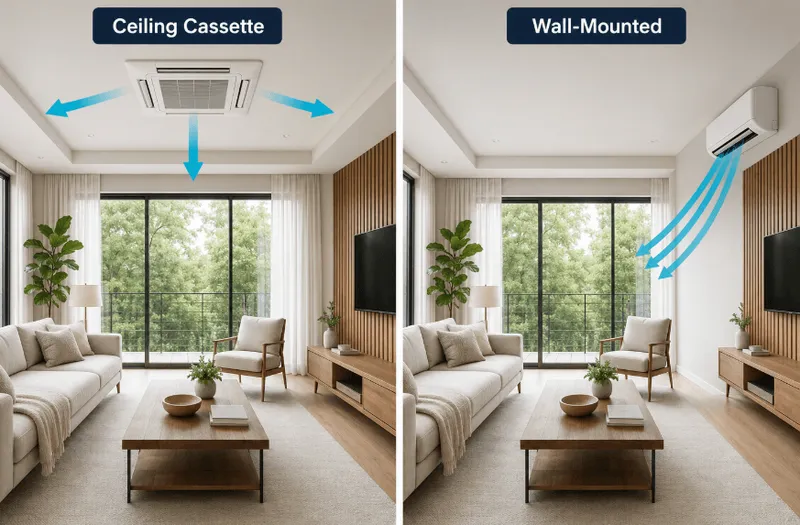
A wall-mounted mini split mounts to a bracket and connects outdoors through a small wall penetration, usually finished in a day. A cassette asks more of the space and crew:
Ceiling cavity depth: roughly 22.5 inches of clear space for the unit and drain pan.
Access panel: built in near the unit for future service without cutting the ceiling again.
Condensate pump: gravity often cannot carry condensate to a drain, so many installs add a small pump.
Line set and structure: refrigerant and drain lines route through the cavity, sometimes around joists or rafters.
Finish work: the cutout gets trimmed with a decorative panel matching the ceiling.
“The install itself is rarely the hard part. The ceiling is. I've turned down more cassette jobs for lack of plenum depth than for any other reason, so measure that clearance before you fall for the look, not after the quote comes back higher than you expected,” says David Clark, Licensed HVAC Technician.
Sometimes, and the ceiling type decides it before the budget does. Drop or suspended tile ceilings are the easiest retrofit candidates, since an installer can lift a tile instead of cutting drywall. Drywall ceilings with no attic space above generally need a false ceiling built down, adding cost and cutting into room height, and an eight-foot flat ceiling with no attic rules out a cassette without renovation. New construction sidesteps this entirely.
If your home lacks a drop ceiling or open attic above the room, get a wall-mounted quote alongside the cassette quote. The retrofit cost gap usually settles the decision.
The filter sits just behind the grille, and reaching it does not require opening the full access panel. See Filterbuy's complete mini split cleaning guide for coils, the blower wheel, and the drain line.
Turn off the unit and disconnect its power source.
Open the decorative panel or drop-down grille on the cassette.
Slide the washable filter panel out, holding it level so dust does not fall back in.
Vacuum the filter on low suction, or rinse it with a damp cloth or lukewarm water below 104°F.
Let the filter air dry fully out of direct sunlight before reinstalling it.
Slide the dry filter back into place and close the grille.
Clean the filter roughly every two weeks during heavy season, or monthly during lighter use. Replace a filter instead of washing it once torn or unable to come clean. Anything beyond the filter, such as the drain pump or evaporator coil, is a job for a licensed HVAC technician.
Ceiling cassettes generally cost more to buy and install than wall-mounted units of the same capacity, largely because of the extra ceiling work, access panel, and, in many homes, a condensate pump. A single cassette can sometimes condition an open floor plan that would otherwise need two or three wall-mounted units, narrowing the price gap. ENERGY STAR's ductless heating and cooling guidance is a good starting point for comparing certified, efficient models. Ask your installer to break out ceiling work and the pump as separate line items, since labor usually drives the surprise.
How much ceiling cavity depth does my home have? Ask for a tape-measure number, not an estimate.
Does this quote include a condensate pump, or is that a separate add-on?
Where will the access panel go? Sign off before the ceiling gets cut.
What's the total cost difference versus a wall-mounted unit here?
Who do I call for filter cleaning versus a coil or drain issue?
“After manufacturing filters for over a decade and serving more than two million households, we know that the type of mini split you choose changes how easy it is to keep the filter clean. A ceiling cassette hides the unit well, but you still need clear, comfortable access to that filter so cleaning it becomes a habit and not a chore,” says David Heacock, Founder and CEO of Filterbuy.
The EPA's Report on the Environment notes indoor pollutant levels are often 2 to 5 times higher than outdoors, part of why an accessible filter matters regardless of mounting style.
The Department of Energy's Building America Solution Center confirms how a cassette sits above the ceiling.
Filterbuy's full mini split mounting comparison lines up wall, ceiling, floor, and concealed duct units.
Filterbuy's complete mini split cleaning guide covers the filter, coils, blower wheel, and drain line.
ENERGY STAR's ductless heating and cooling guidance breaks down certified versus standard models.
The EPA's Report on the Environment finds indoor air can run 2 to 5 times dirtier than outdoor air.
Filterbuy's mini split systems let you compare BTU sizes and coverage areas, factory-direct.
Filterbuy's seasonal mini split maintenance schedule outlines what to handle yourself and when to call a technician.
Heating and cooling use 52% of a typical U.S. home's yearly energy.
Source: U.S. Energy Information Administration, Use of Energy in Homes
8.6% of U.S. adults currently have asthma, making easy filter access especially important.
Source: CDC, National Center for Health Statistics, FastStats: Asthma
96% of regional HVAC contractors reported installing ductless systems by 2021.
Source: Northwest Energy Efficiency Alliance (NEEA), HVAC Market Transformation
Most need close to 22.5 inches of clear cavity depth, plus room for a nearby access panel. A licensed installer should confirm exact clearance for your unit.
Many homeowners find them quieter at a comparable airflow level, since a larger fan spreads air across a wider area instead of one direct stream.
No. Installation involves refrigerant line work, electrical connections, and often structural work, all requiring a licensed HVAC technician.
Clean the washable filter about every two weeks during heavy season, and monthly during lighter use. Replace it instead of cleaning it once it is torn or will not come clean.
Yes, in most cases. The extra ceiling work, access panel, and often a condensate pump add to cost versus a wall-mounted unit of the same capacity.
Ceiling Cassette: A ductless mini split indoor unit installed flush inside the ceiling, releasing air through a grille instead of a wall-mounted housing. Also called a mini split cassette.
Recessed Mini Split: Another name for a ceiling cassette mini split, describing how the indoor unit sits recessed into the ceiling cavity.
Flush Mount Ductless AC: A ductless air conditioning unit, most often a ceiling cassette, installed so it sits level with the surrounding ceiling or wall surface.
Wall-Mounted Mini Split: A ductless mini split indoor unit mounted on a wall, typically near the ceiling, with a visible housing and directional airflow.