Shop by
Your Tesla Model 3 takes a HEPA-certified cabin air filter that captures 99.97% of airborne particles down to 0.3 microns. Filterbuy builds these filters in the USA to exact OEM tolerances, so they seal the way your Model 3 was designed — no bypass air sneaking around the edges.
Road dust, pollen, mold spores, smoke, smog, pet dander, and PM2.5 get trapped in the media instead of reaching your seats. Not sure which one fits your year? The quiz below sorts it out in about 30 seconds.
5-Year Warranty · Made in the USA · Free 2-Day Shipping · 1, 2, 3 & 4-Packs

Answer 3 quick questions and we’ll match you to the right filter for your Model 3.
Driving something else? Browse auto cabin air filters for hundreds of vehicles.
By Michelle Wan, Brand Manager and Air Quality Writer, Filterbuy
Reviewed by David Clark, Licensed HVAC Technician, Filterbuy
Published August 6, 2026 | Updated August 6, 2026
The Tesla Model 3 cabin air filter sits in the passenger-side footwell behind the center console trim, not behind the glove box. Replacement takes about 30 minutes and needs two filters, a T20 Torx driver, and a plastic trim pry tool. Tesla specifies every two years; drivers in dusty, smoky, or high-pollen areas should change annually.
The Model 3 uses two stacked cabin air filters, replaced as a pair. OEM part numbers: 1107681-00-A and 1107681-00-C.
Tesla’s official interval is every two years, or annually in China.
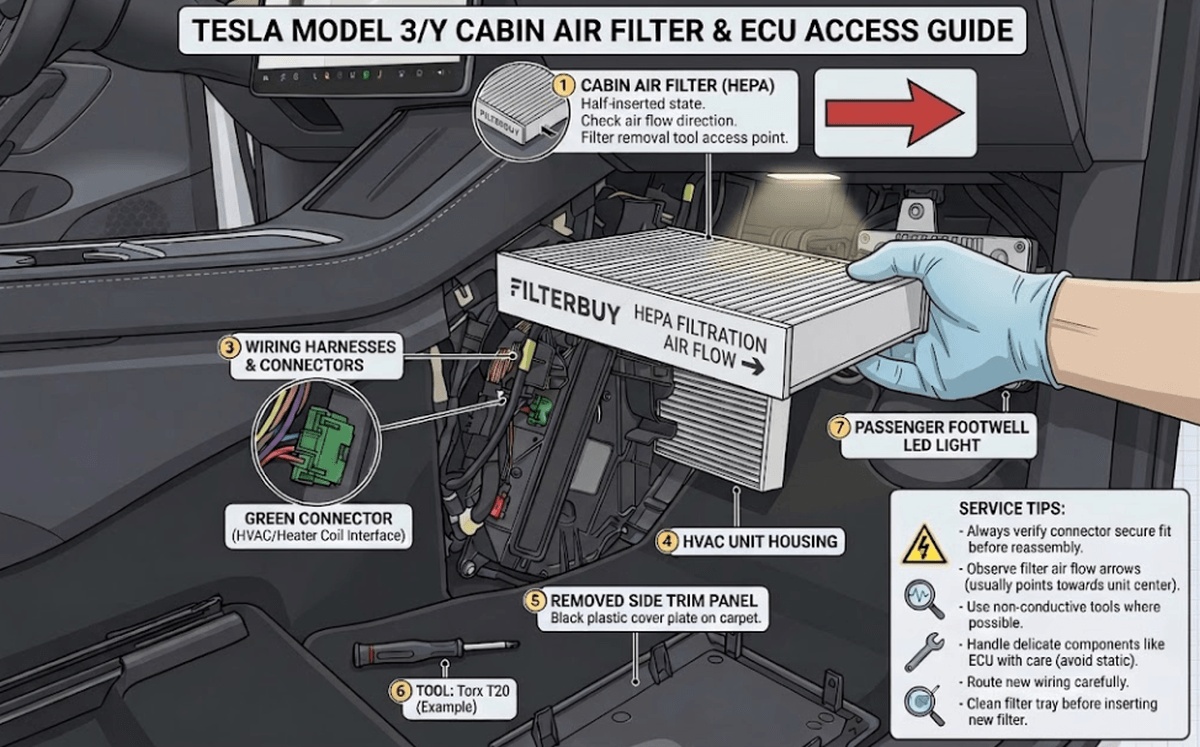
Both arrows must face the rear of the vehicle. Installing a filter backward is the most common mistake.
Orange high-voltage cables attach to the filter cover. Tesla warns damaging them can cause serious injury or death.
Cover fasteners vary by build: a T20 screw, a T20/6mm hybrid fastener, or squeeze tabs.
Three errors recur across Model 3 filter guidance.
"It’s behind the glove box." True for most cars, wrong for this one. Generic advice sends Model 3 owners to a panel with nothing behind it.
A three-year replacement interval. Several maintenance sites publish this figure. Tesla’s documentation says two years.
No mention of the high-voltage cables. Tesla’s procedure carries an explicit injury-or-death warning about the orange HV cables on the cover. Most write-ups omit it.
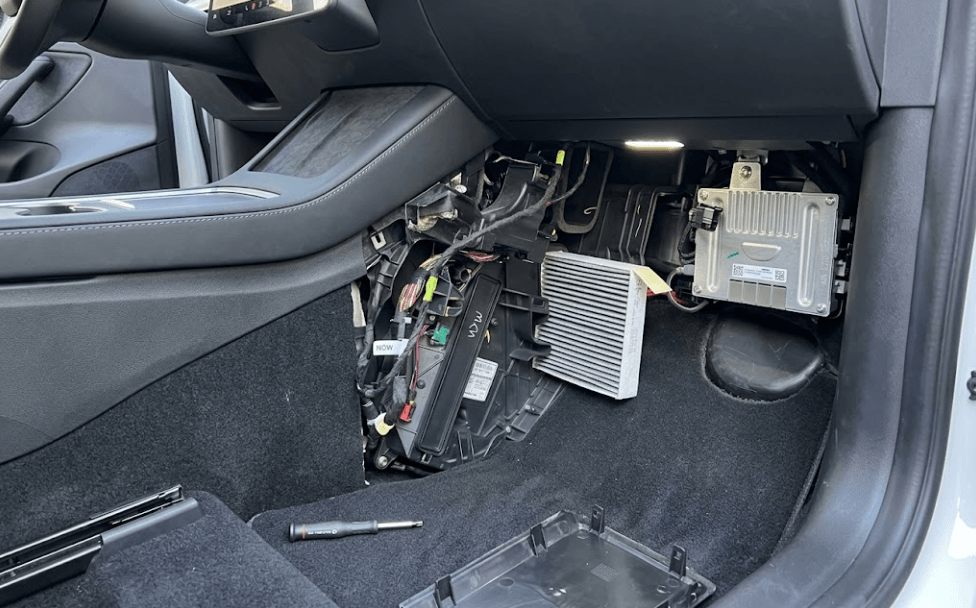
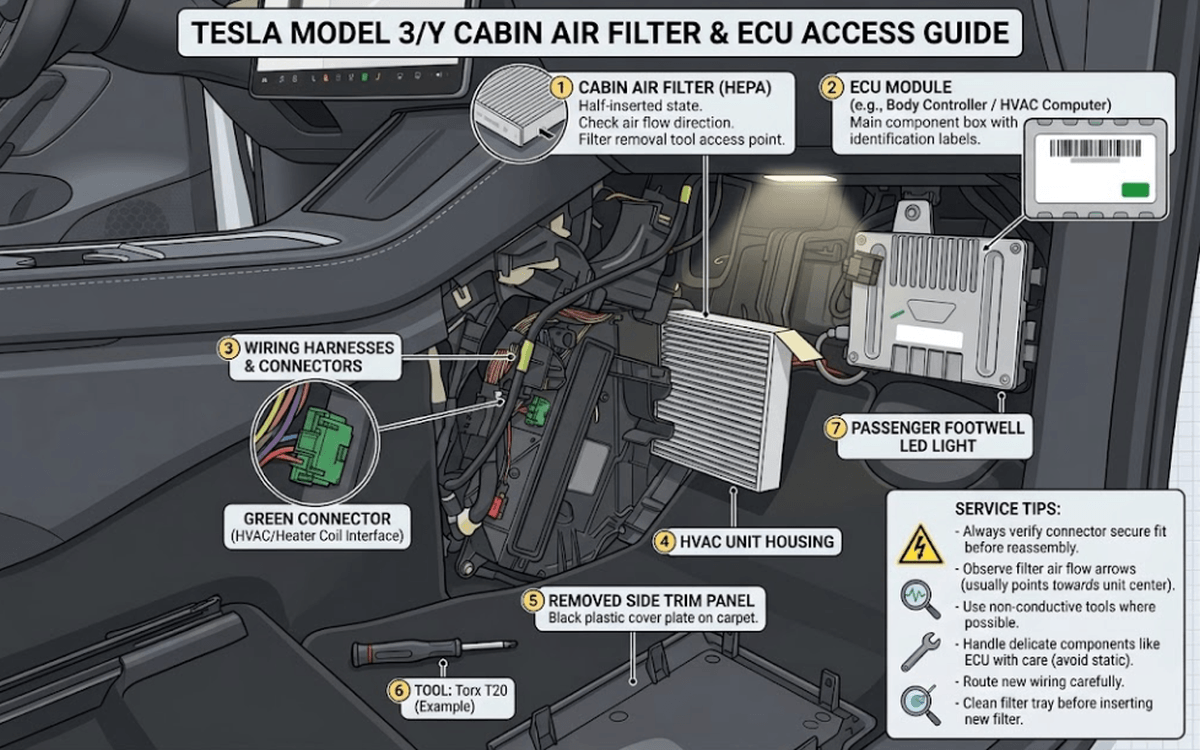
The Tesla Model 3 cabin air filter sits inside the HVAC module in the front passenger footwell, reached by removing the footwell cover and the right side panel of the center console. There are two filters, stacked vertically. Tesla’s service documentation routes the job this way. For how a cabin filter differs from an engine filter, see Filterbuy’s comparison of the two.
Tesla recommends replacing Model 3 cabin filters every two years, or yearly in China. Aftermarket guidance runs shorter, because a filter’s life depends more on what you drive through than on elapsed time.
Tesla specifies every year for vehicles in China. Treat two years as the ceiling rather than the target.
Change annually if you sit in heavy traffic, face wildfire smoke, park under pollen-heavy trees, or drive unpaved roads. Change sooner if airflow weakens, the windshield is slow to defog, or allergies flare while driving. Filterbuy’s guide to how often to change a cabin air filter explains why a dusty-city filter loads twice as fast.
Budget about 30 minutes for a first attempt and 15 minutes for a repeat.
Replacing both filters takes about 30 minutes, following Tesla’s official procedure. Work slowly at steps 3 and 5, where the connectors and high-voltage cables are.
Turn off the climate control system. A running blower pulls debris into the open housing.
Slide the front passenger seat fully rearward and remove the floor mat.
Release the passenger-side footwell cover. Pop the push clips with the pry tool, support the cover, then disconnect its two connectors, one for the light and one for the speaker. Pull the plastic bodies, not the wires.
Remove the right side panel of the center console, working top to bottom until the clips release.
Orange high-voltage cables attach to the cabin filter cover. Tesla warns that stretching, bending, or damaging them can result in serious injury or death, and says to stop immediately if they are damaged. Never let the cover hang by the cables. If working near HV cabling makes you uneasy, hand this job to a technician.
Remove the cabin filter cover. Take out the T20 screw and set it aside. Some builds use a T20/6mm hybrid fastener, or two squeeze tabs you pinch before tilting the cover out.
Fold the upper filter’s tab up and the lower filter’s tab down.
Pull the upper filter straight out by its tab.
Pull the lower filter upward, then out.
Insert both new filters with the arrows facing the rear of the vehicle. Seat the lower filter first, then the upper above it. A reversed filter loads unevenly and filters poorly.
Fold the tabs inward so the cover seats flush.
Refit the cover, lower tab first, then torque the screw to 1.2 Nm (0.89 ft-lb). Resecure the bottom tabs instead if your build uses them.
Reconnect both connectors and press the footwell cover onto its push clips.
Realign the console side panel with its locator slots and press until every clip seats.
Reinstall the floor mat and return the seat.
Reset the cabin filter interval under Controls > Service > Maintenance. Most guides omit this, and skipping it leaves your Model 3 counting from the old date.
A sour, wet-sock smell when the fan starts is among the most widely reported Model 3 HVAC complaints, and fresh filters often fix it only for weeks. Condensation from the A/C evaporator wets the lower filter, letting mildew grow on the filter and the coil.
Replace the filters first and inspect what comes out. If the smell returns within weeks, the growth is on the evaporator coil and no filter will cure it. That needs an evaporator cleaning, not more filters.
Filter media matters more on a Model 3 than on any other Tesla. It is the only model without Bioweapon Defense Mode, because the factory HEPA assembly used in Model S, X, and Y is too large to fit. Your two filters are the whole filtration system.
The Model 3 has no factory HEPA assembly, so filter media choice carries more weight than it does on Model S, Model X, or Model Y.
HEPA is a defined standard, not a marketing word. The EPA sets it at 99.97% capture at 0.3 microns, the hardest size to catch, so larger and smaller particles are trapped more efficiently still. Whatever you choose, confirm it is built to OEM dimensions, because a filter that does not seal lets air bypass entirely. Filterbuy’s guide to choosing a cabin air filter matches media to conditions.
Recirculation cuts ultrafine particles by roughly 90%, but exhaled CO2 climbs to 2,500–4,000 ppm with passengers aboard. In UCLA testing of 12 vehicles, a high-efficiency filter on outside air matched that reduction while CO2 stayed at 620–930 ppm. Better media buys fresh air and clean air together.
Seven sources, in the order you will want them. All verified August 5, 2026.
Source: Tesla official service documentation
The full procedure, free to owners, with the HV warning and torque spec.
Source: Tesla Model 3 maintenance service intervals
The two-year interval, against the three years some blogs report.
Source: Tesla vehicle maintenance support
How to log the change so the interval restarts correctly.
https://www.tesla.com/support/vehicle-maintenance
Source: U.S. Environmental Protection Agency
The standard behind the 99.97% claim, and why 0.3 microns is hardest to catch.
https://www.epa.gov/indoor-air-quality-iaq/what-hepa-filter
Source: U.S. Environmental Protection Agency
Efficiency by particle size, for judging any filter rating.
https://www.epa.gov/indoor-air-quality-iaq/what-merv-rating
Source: Filterbuy
Media matched to traffic, pollen, smoke, or dust.
https://filterbuy.com/resources/filters/cabin/how-to-choose-a-cabin-air-filter-guide/
Source: Filterbuy
Mileage guidelines and the symptoms of early failure.
https://filterbuy.com/resources/filters/cabin/how-often-to-change/
Three findings from U.S. research behind this guide.
1. A high-efficiency cabin filter cut in-cabin PM2.5 by 37% and ultrafine particles by 47%.
Study: 17 Los Angeles taxis. 300 hours. 11,000 kilometers of driving.
Key detail: Closing windows with the stock filter changed almost nothing; the upgraded filter did.
Source: Yu et al., PLOS ONE (2017), UCLA. Funded by NIOSH and the CDC.
https://pmc.ncbi.nlm.nih.gov/articles/PMC5703570/
2. High-efficiency filters removed about 93% of ultrafine particles. Factory filters averaged roughly 50%.
Study: 12 vehicles, tested with no filter, the factory filter, and two high-efficiency ones.
Key detail: The OEM filter is a floor, not a ceiling, and the Model 3 has no factory HEPA to fall back on.
Source: Lee and Zhu, Environmental Science & Technology (2014), UCLA.
https://pubmed.ncbi.nlm.nih.gov/24471775/
3. 152.3 million people in the U.S., or 44%, live in counties with failing grades for ozone or particle pollution.
Data: 2022–2024 monitoring from official monitors nationwide.
Why it matters: Commute through one of those counties and your cabin filter is the last barrier before your lungs.
Source: American Lung Association, "State of the Air" 2026 (27th annual edition).
Two, stacked in the HVAC module. Replace them as a pair. A fresh filter beside a loaded one still restricts airflow.
No. It is reached through the passenger footwell and center console side panel. Model S and Model X place theirs under the hood.
Yes. A T20 Torx driver and a plastic trim pry tool are all you need, and Tesla publishes the full procedure. A service center charges $50–$150 with labor; DIY costs only the filters. The one real caution is the high-voltage cabling.
No. Tesla documents it as owner-serviceable and sells the filters directly to owners.
There is no standard size to measure, as with home filters. Order by Tesla part number 1107681-00-A or 1107681-00-C, or by vehicle fitment. Two are required.
Tesla publishes one procedure for Model 3, and aftermarket sets list fitment through the 2024 refresh. Confirm against your build.
Filterbuy has manufactured air filters in the United States since 2013, at plants in Alabama, Florida, Pennsylvania, and Utah. The company makes over 600 standard sizes plus custom builds, and its automotive line uses HEPA-certified media cut to OEM tolerances.
Cabin air filter: Filters outside air entering the passenger compartment through the HVAC vents. EVs have no engine air filter.
HVAC module: The housing containing a vehicle’s heating, ventilation, and air conditioning components, including both cabin filters.
HEPA (High-Efficiency Particulate Air): A standard requiring capture of at least 99.97% of particles at 0.3 microns, the most-penetrating size. Tesla fits HEPA assemblies to Model S, X, and Y, but not Model 3.
Bioweapon Defense Mode: Tesla’s cabin feature pairing a large HEPA filter with software that pressurizes the cabin. Not on Model 3.
Activated carbon: A treated layer that adsorbs gases and odors, such as exhaust fumes, which particle filtration alone leaves behind.
PM2.5: Fine particulate matter 2.5 microns or smaller, linked to wildfire smoke, traffic exhaust, and respiratory effects.
