Shop by
Which Years Have One, Where It Is, and How to Replace It
Written by Michelle Wan. Reviewed for technical accuracy by David Clark, Licensed HVAC Technician.
Published July 29, 2026. Last updated July 29, 2026.
Ford began installing cabin air filters in the F-150 with the 2015 model year. On 2015 and newer trucks the filter sits behind the glove box and takes under 10 minutes to change with no tools. F-150s built from 1997 through 2014 left the factory without one, even though parts catalogs list a number for them. Motorcraft lists replacement at 12 months or 15,000 miles.
The F-150 got a factory cabin air filter starting with the 2015 model year. Trucks from 1997 through 2014 did not.
Parts catalogs list filter numbers for 2004–2014 F-150s, which is why owners buy parts their truck cannot accept.
On 2015 and newer trucks the filter sits behind the glove box, reached by squeezing the glove box stops.
Ford.com lists the Motorcraft FPP92 (part MU2Z19N619A) as current. It follows the FP-92 and the earlier FP-79.
Motorcraft lists replacement at 12 months or 15,000 miles. Jobsite and gravel-road use loads a filter faster.
Your F-150 has a factory cabin air filter if it is a 2015 model year or newer. Trucks built from 1997 through 2014 were not equipped with one, even though aftermarket catalogs list part numbers for them. Confirm this first, because the catalogs disagree with the assembly line.
Ford began factory-installing cabin air filters in the F-150 with the 2015 model year. Confirm your truck against its VIN or owner's manual before buying a filter.
If a parts site sold you a filter for a 2012 F-150, it sold you a part with no home.
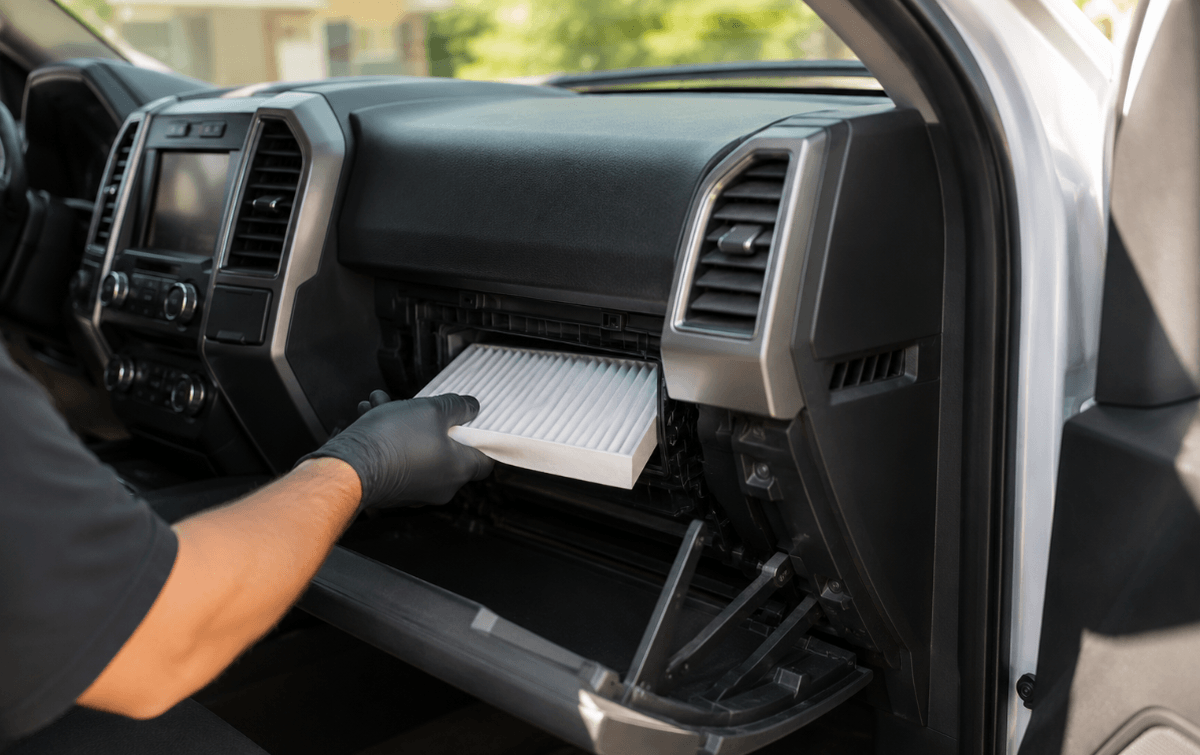
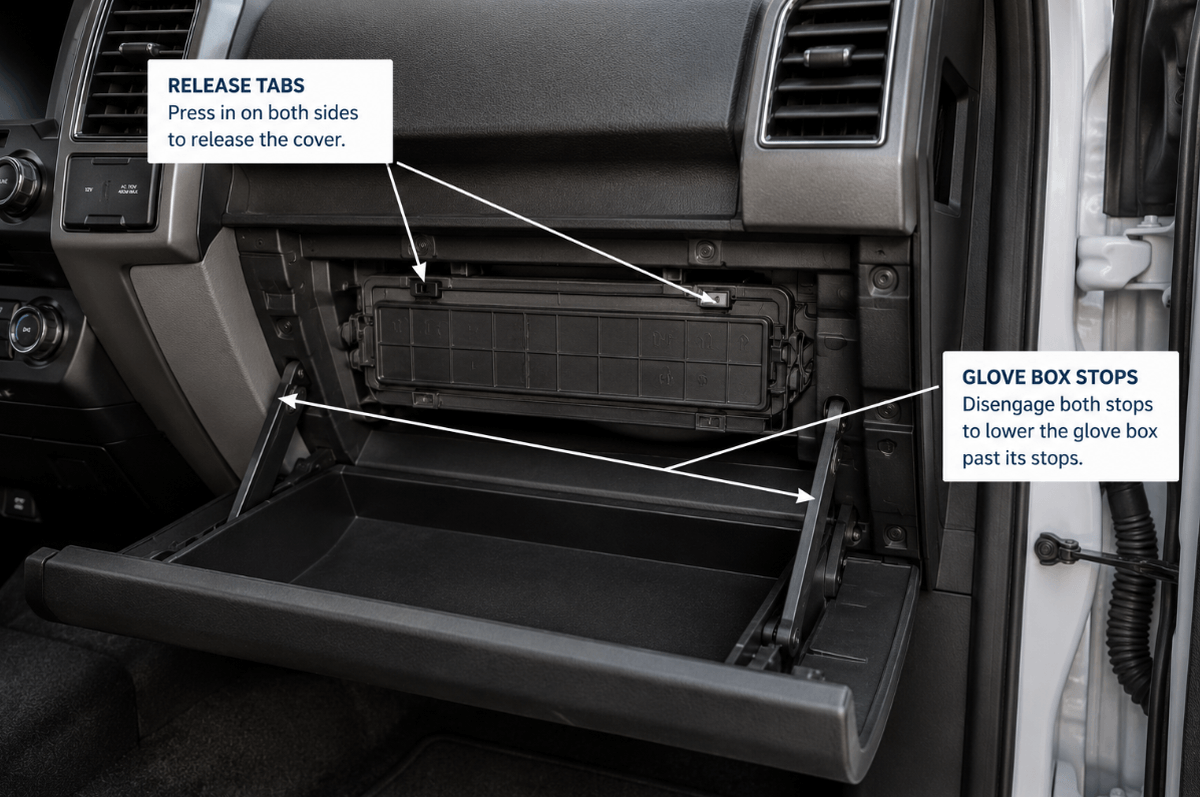
On a 2015 or newer F-150, the cabin air filter sits behind the glove box on the passenger side. Empty the glove box, squeeze the sides inward to clear the stops, and let the door swing down. The filter cover is directly behind it, held by plastic tabs. No trim removal required.
The same layout carries over to the F-250 through F-550 Super Duty, Expedition, and Lincoln Navigator, which is why one part number covers so much of Ford's truck lineup. More on where the cabin air filter is located.
Ford.com lists the Motorcraft FPP92 (Ford part MU2Z19N619A) as the current cabin filter for 2015 and newer F-150s. It follows the FP-92 and FP-79 in the same housing and measures roughly 10-1/4 by 8-1/16 by 1-9/16 inches.
Dimensions are approximate and come from retailer listings, not a Ford spec sheet. Cross-reference numbers are not a fitment guarantee. Verify against your VIN before ordering.
A part number says nothing about what the filter captures. Ford's listing states the Motorcraft filter captures 90% of particles 10 microns or larger, which leaves out most of what a truck drives through.
Replacing the filter on a 2015 or newer F-150 takes under 10 minutes and no tools. Work with the engine off and the truck in park.
Empty the glove box completely.
Squeeze both sides of the box inward to clear the stop tabs, then let it hang open.
Press the tabs on each side of the filter cover and lift it off.
Note the airflow arrow, then slide the old filter straight out and keep it level. A loaded filter sheds debris.
Install the new filter with the arrow pointing down. Backward installation lets unfiltered air bypass the media.
Snap the cover back on and lift the glove box until the stops re-engage.
Never vacuum or wash a disposable filter. Vacuuming releases trapped allergens into the cabin and washing destroys the electrostatic charge that does much of the work. For photographs of every step, see iFixit's 2015–2017 F-150 guide.
Motorcraft lists 12 months or 15,000 miles, whichever comes first. Dealer schedules often quote 20,000. Either assumes moderate climate and mixed highway driving, which describes few working F-150s, and the truck gives no dashboard alert when the filter loads up. Confirm yours with Ford's VIN maintenance lookup.
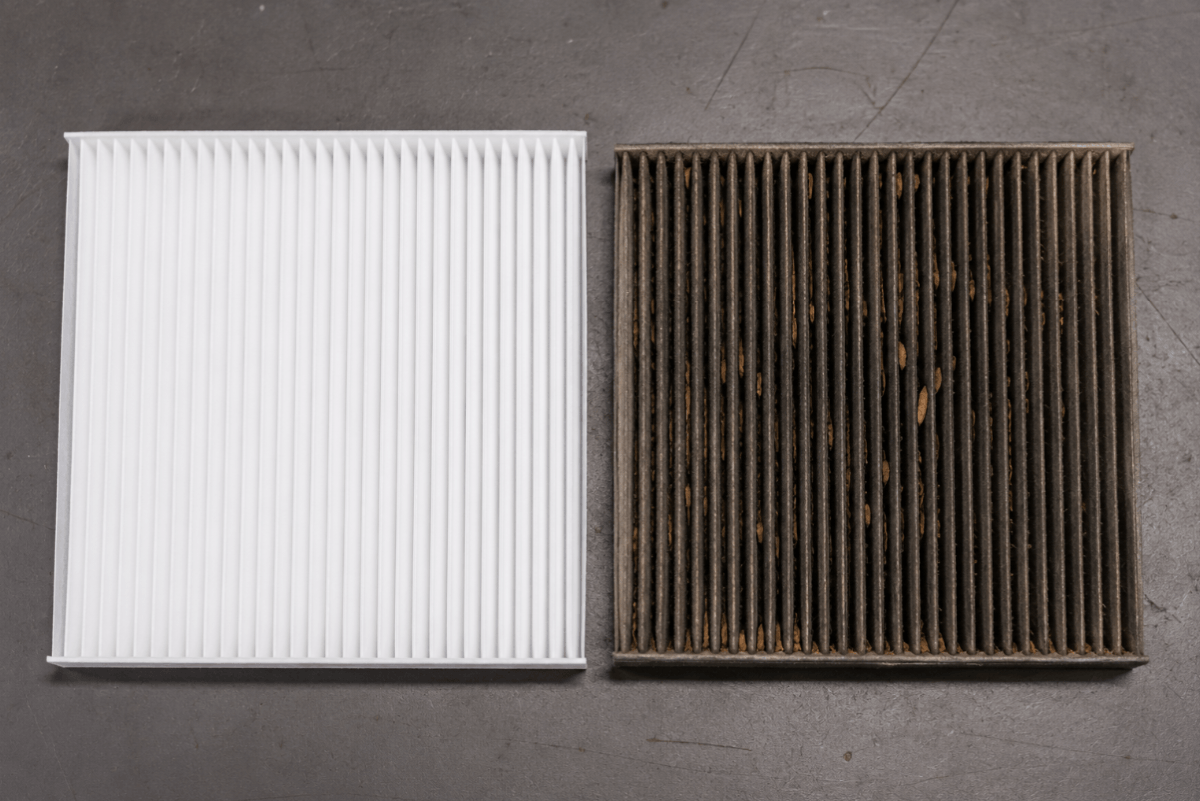
Skip the chart and check it yourself. Pull the filter every other oil change. Gray-brown and matted means replace it now. Still white with light dust means your airflow problem is somewhere else. Check that it sits square in the housing too, because a crooked or undersized filter lets unfiltered air slip around the edges.
Motorcraft's published interval is 12 months or 15,000 miles. The rows below it reflect duty cycles that load a filter faster than that schedule assumes.
A fresh filter stops new debris entering. It does not clean what is already growing inside the system. The musty smell most owners chase is usually mold on the air conditioning evaporator core, where condensate collects and never fully dries.
In-cabin PM2.5 fell from 20 micrograms per cubic metre without a filter to 14 with one. Source: Mallach G, et al., Environmental Science and Technology, 2023;57(8):3238–3247. Read the study.
For scale, a human hair measures about 70 micrometres across and the largest fine particle measures 2.5. Particles that size reach deep into the lungs and some enter the bloodstream, per the EPA. A filter rated for 10 microns is not built for that range.
Ford owner's manuals: the only source that settles the interval for your model year.
Ford VIN maintenance lookup: enter your VIN and mileage for your truck's schedule.
Ford's Motorcraft cabin filter listing: specifications and dealer price.
iFixit's 2015–2017 F-150 guide: the replacement photographed step by step.
Infinity Overland on the 2009–2014 omission: plus a direct-fit retrofit kit.
FTC on auto warranties: aftermarket parts do not void your warranty.
No. The 2012 F-150 left the factory without one. Ford's 12th generation used an HVAC design with no replaceable filtration media. A retrofit kit can add one.
How much does a Ford F-150 cabin air filter cost?
The filter runs $15 to $50 depending on media. Dealership replacement runs $50 to $150 with labor. The job takes under 10 minutes with no tools, so most of that labor is avoidable.
Cabin air filter. Cleans outside air before it enters the passenger compartment through the HVAC system. Separate from the engine air filter.
Motorcraft. Ford's own parts and service brand. FPP92 is the current F-150 cabin filter.
PM2.5. Fine particulate matter 2.5 microns or smaller, which the EPA links to respiratory and cardiovascular effects.
HEPA. A media standard requiring 99.97% capture of particles at 0.3 microns.
